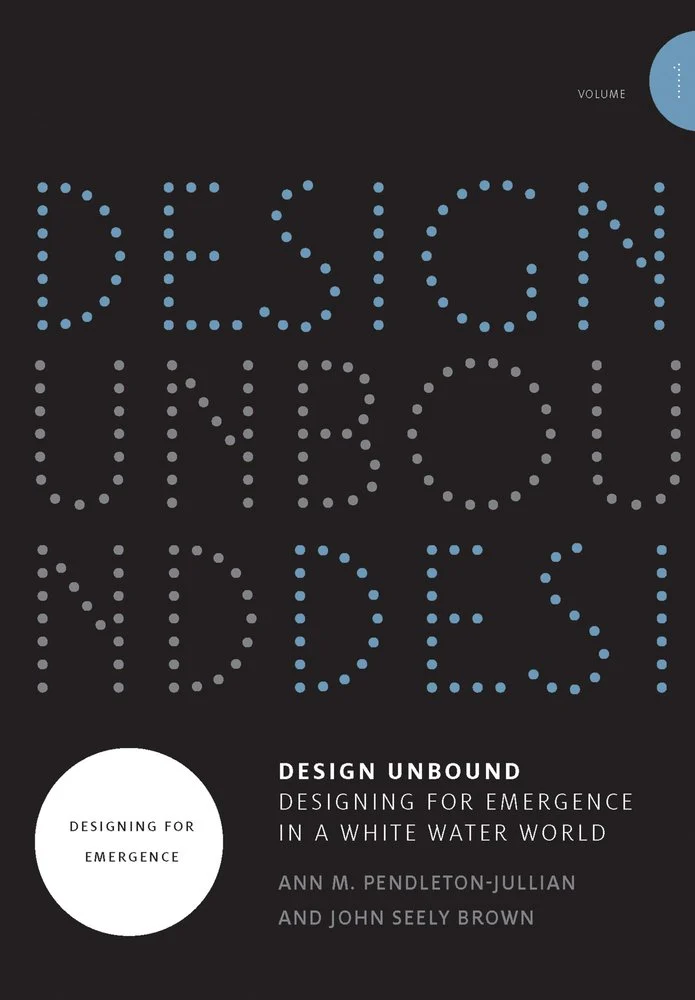
Design Unbound challenges traditional approaches to design rooted in predictability, stability, and control. Drawing from systems thinking, complexity science, architecture, cybernetics, and organizational theory, Ann M. Pendleton-Jullian and John Seely Brown argue that modern systems must be understood as dynamic, evolving, and deeply interconnected.
Rather than treating design as the creation of finished artifacts, the book frames design as the shaping of conditions within living sociotechnical systems. It emphasizes emergence, adaptability, experimentation, participation, and the continual negotiation between coherence and change.
The authors critique mechanistic planning models that assume stable environments and predictable outcomes, instead proposing approaches capable of engaging uncertainty and complexity directly. Design becomes less about enforcing order and more about cultivating environments where intelligent adaptation can occur.
Throughout the book, design is positioned not merely as aesthetics or problem-solving, but as an epistemic practice: a way of learning with systems while participating in their evolution.
Why this belongs here
Design Unbound aligns deeply with Knowledge Flow’s understanding of intelligence as something emergent, relational, and adaptive.
Knowledge systems cannot be designed like static machines because meaning itself evolves through interaction, feedback, interpretation, and time. The book helps illuminate why rigid control structures often suppress learning while adaptive structures support emergence and resilience.
Its emphasis on designing conditions rather than prescribing outcomes reflects a foundational principle of Knowledge Flow: intelligence arises through participation in living systems, not through top-down certainty alone.