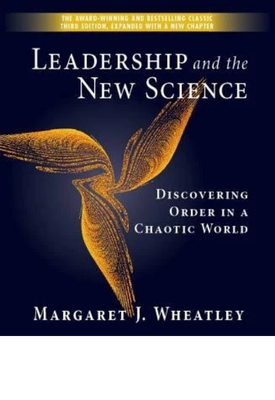
In Leadership and the New Science, Margaret Wheatley draws from systems theory, complexity science, quantum physics, and ecology to challenge mechanistic assumptions about organizations and leadership.
The book argues that organizations function less like predictable machines and more like living systems characterized by emergence, interdependence, uncertainty, and continual adaptation. Attempts to impose rigid control often fragment systems and reduce their ability to learn and respond intelligently to changing conditions.
Wheatley emphasizes relationship as a foundational organizing force. Meaning, trust, identity, and coordination emerge through interaction rather than through hierarchy or structure alone. Information itself becomes a living force within systems, shaping behavior through patterns of connection and participation.
The book also explores the importance of self-organization, shared meaning, and resilience within complex environments. Rather than attempting to eliminate uncertainty, Wheatley advocates cultivating conditions that allow systems to adapt and evolve.
Her writing blends organizational insight with philosophical reflection, emphasizing attentiveness, presence, and relational awareness as essential leadership capacities.
Why this belongs here
Leadership and the New Science strongly reinforces Knowledge Flow’s understanding of organizations as living sociotechnical systems.
Knowledge cannot be reduced to static information transfer or managerial control. It emerges through relationships, interaction, participation, and adaptation across time.
Wheatley’s work also highlights the importance of coherence without rigidity — a core concern of Knowledge Flow. Systems become more intelligent not through tighter control alone, but through stronger conditions for connection, reflection, and collective learning.