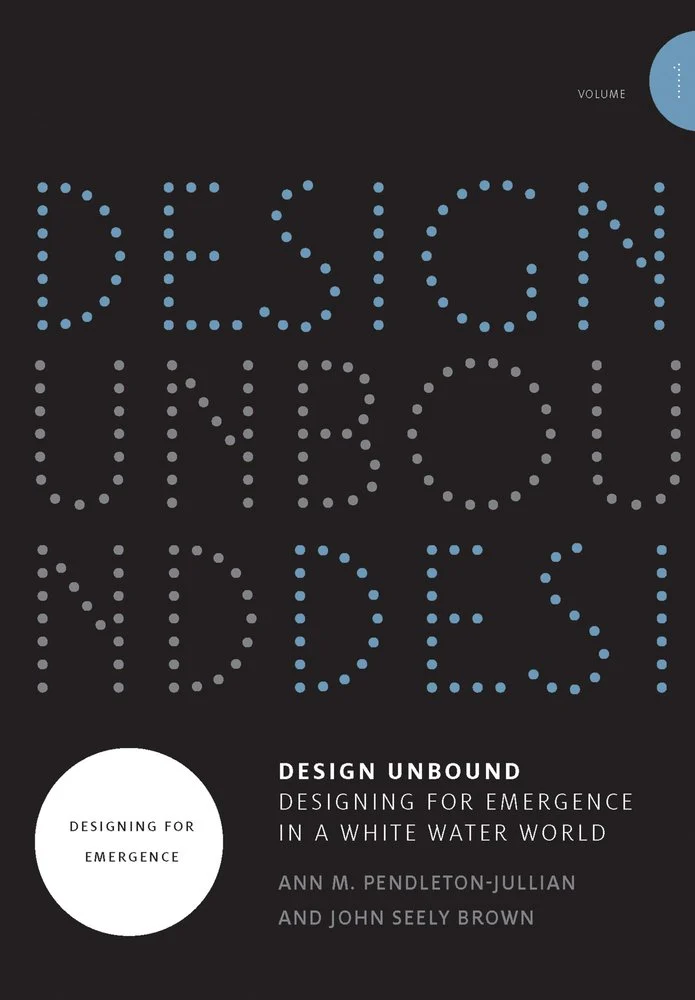

Ann Pendleton-Jullian is an architect and theorist whose work expands architecture beyond buildings into the broader design of dynamic sociotechnical systems. Drawing from complexity science, cybernetics, systems thinking, and ecological design, she explores how humans shape — and are shaped by — evolving environments.
Her work argues against static, mechanistic models of planning and control. Instead, she frames design as an adaptive process of participation within living systems characterized by uncertainty, emergence, feedback, and continual transformation.
Pendleton-Jullian is particularly interested in the relationship between structure and possibility: how systems can create enough coherence to function while remaining open enough to evolve. Her writing often explores the tensions between order and emergence, stability and experimentation, intentionality and adaptation.
Rather than treating architecture as the creation of fixed artifacts, she positions it as the ongoing shaping of conditions that support resilient, intelligent, and evolving systems across technical, organizational, cultural, and ecological scales.
Relevance to Knowledge Flow
Pendleton-Jullian’s work aligns deeply with Knowledge Flow’s view that intelligence emerges through participation in dynamic systems rather than through rigid control.
Knowledge systems must balance coherence with adaptability. Too much structure suppresses emergence; too little structure dissolves meaning and continuity. Pendleton-Jullian’s work helps illuminate how environments can sustain both stability and evolution simultaneously.
Her perspective reinforces a foundational principle of Knowledge Flow: systems are not static objects to optimize, but living relationships to cultivate over time.