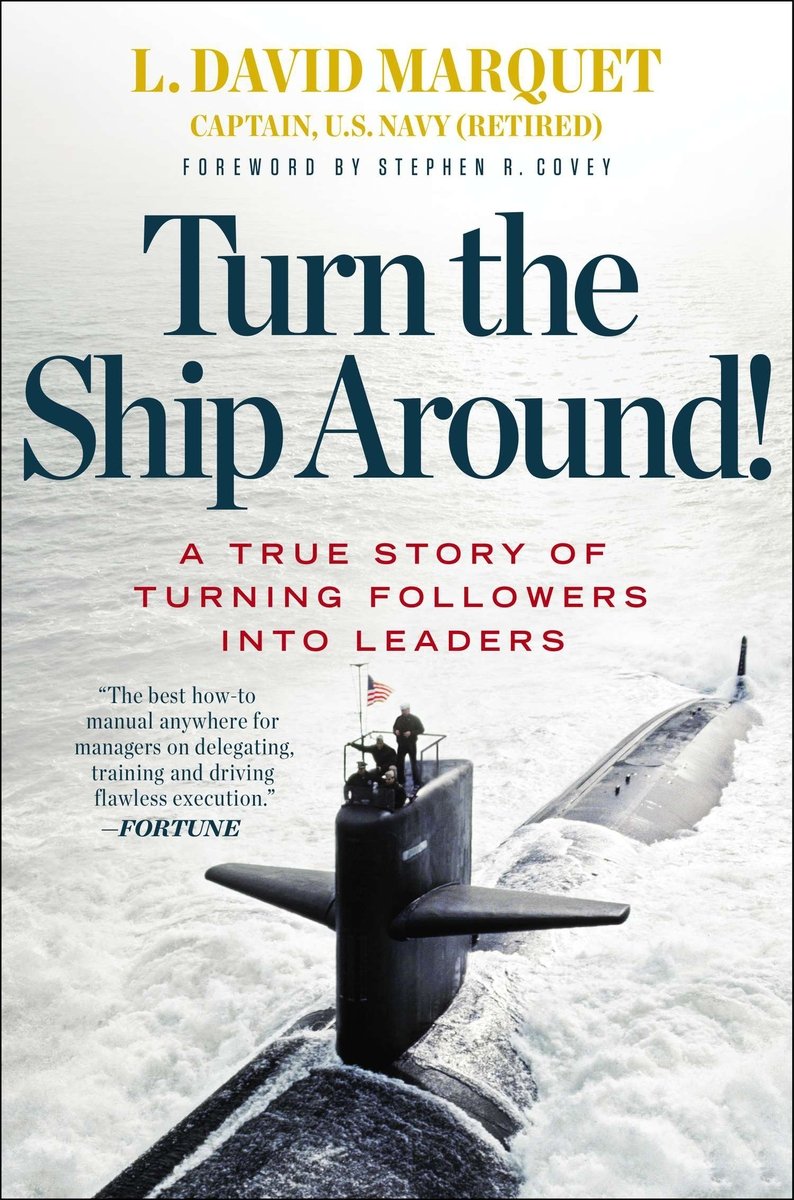
In Turn the Ship Around!, David Marquet recounts his experience transforming the USS Santa Fe from one of the worst-performing submarines in the U.S. Navy into one of its highest-performing crews.
Marquet critiques traditional command-and-control leadership structures that centralize authority while unintentionally suppressing initiative, learning, and situational awareness. In highly complex environments, these structures create dependency patterns where people wait for instructions rather than actively engaging with the system around them.
The book introduces intent-based leadership: a model where decision-making authority moves closer to where knowledge and operational context actually exist. Rather than treating leadership as issuing orders, Marquet reframes it as designing conditions where people can think, contribute, and adapt intelligently.
Small changes in language, participation, and authority structures become powerful mechanisms for redistributing ownership and increasing collective capacity.
Throughout the book, leadership is framed less as personal heroics and more as the cultivation of organizational learning and distributed intelligence.
Why this belongs here
Turn the Ship Around! aligns deeply with Knowledge Flow’s emphasis on distributed intelligence and adaptive participation.
Knowledge systems become fragile when authority structures disconnect decision-making from lived context and local understanding. Healthy systems cultivate observation, interpretation, initiative, and learning throughout the organization rather than concentrating them at the top.
Marquet’s work reinforces the idea that leadership is not simply directing action, but creating environments where intelligence can emerge collectively through participation and trust.