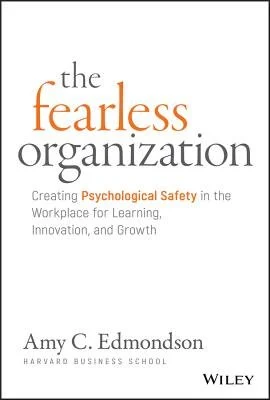
In The Fearless Organization, Amy Edmondson examines the role psychological safety plays in enabling learning, innovation, and adaptive performance within organizations.
The book argues that complex work environments require systems where people can ask questions, express uncertainty, challenge assumptions, admit mistakes, and contribute perspectives without fear of humiliation or punishment. When fear dominates, knowledge becomes fragmented, hidden, distorted, or suppressed entirely.
Edmondson distinguishes psychological safety from comfort or lack of accountability. High-performing systems are not conflict-free; rather, they create conditions where productive disagreement, experimentation, and learning can occur openly.
Drawing from healthcare, aviation, technology, and organizational case studies, the book explores how fear shapes communication patterns, decision-making, and the movement of information through systems.
A recurring insight is that many organizational failures occur not because warning signs were absent, but because systems made it unsafe to surface them clearly.
Why this belongs here
The Fearless Organization addresses one of the most important relational conditions underlying Knowledge Flow.
Knowledge cannot move effectively through systems where fear suppresses inquiry, disagreement, uncertainty, or reflection. Psychological safety enables the flow of insight across boundaries by reducing defensive behavior and increasing adaptive learning.
Edmondson’s work reinforces the idea that organizational intelligence depends not only on technical systems or expertise, but on relational environments where people can participate honestly in collective sense-making.