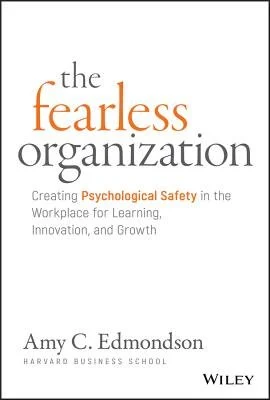

Amy Edmondson’s work explores the relational conditions necessary for organizational learning and adaptive performance. Her research revealed that effective teams are not defined primarily by the absence of mistakes, but by their ability to surface, discuss, and learn from them openly.
She developed the concept of psychological safety to describe environments where people feel able to ask questions, express uncertainty, admit mistakes, challenge assumptions, and contribute perspectives without fear of humiliation or punishment.
Edmondson emphasizes that complex, uncertain work requires systems capable of continuous learning rather than rigid perfectionism. In environments where speaking honestly becomes risky, organizations lose access to critical knowledge about emerging problems, changing conditions, and hidden vulnerabilities.
Her work also explores teaming: the increasingly fluid collaboration patterns found in modern organizations where learning, coordination, and adaptation must occur across shifting groups and boundaries.
Relevance to Knowledge Flow
Edmondson’s work highlights a crucial condition for knowledge flow: people must feel safe enough to contribute what they know.
Knowledge systems fail when fear suppresses uncertainty, disagreement, experimentation, or vulnerability. Psychological safety enables the movement of knowledge across relationships by reducing defensive behavior and increasing openness to learning.
Her work reinforces the idea that organizational intelligence depends not only on technical systems or expertise, but on relational conditions that support trust, participation, and adaptive learning.