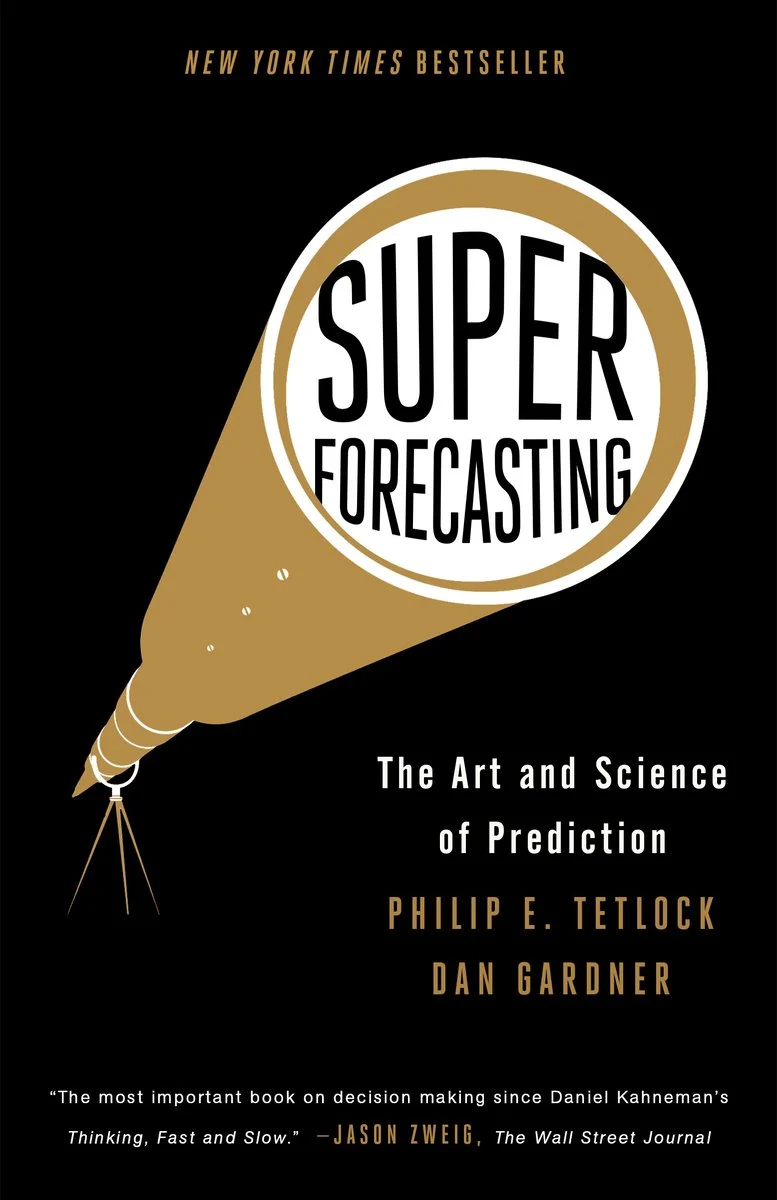
Human beings are naturally drawn to certainty.
We prefer clear explanations, confident predictions, and coherent narratives that make the future feel understandable and manageable.
Yet the world is often uncertain, dynamic, and resistant to simple prediction.
Superforecasting begins with a surprising observation: some people consistently make better forecasts than others. These individuals are not necessarily subject matter experts, nor do they possess exceptional intelligence. Instead, they exhibit a distinctive approach to thinking.
Tetlock’s research found that successful forecasters tend to break complex questions into smaller components, examine multiple perspectives, seek disconfirming evidence, and update their beliefs as new information becomes available. Rather than defending opinions, they treat beliefs as provisional hypotheses.
A recurring theme throughout the book is probabilistic thinking. Superforecasters rarely express certainty. They think in terms of likelihoods, ranges, and degrees of confidence. This allows them to remain adaptable as circumstances change.
The book also explores the dangers of overconfidence. Experts often perform poorly when they become attached to particular theories or narratives. Confidence can create the illusion of understanding while reducing openness to new evidence.
Another key insight is that forecasting improves through feedback. Individuals become better predictors when they regularly evaluate outcomes, compare predictions to reality, and adjust their reasoning accordingly.
At its core, Superforecasting is not simply about predicting the future. It is about learning how to think more clearly under uncertainty. The practices that improve forecasting are the same practices that improve judgment, learning, and decision-making.
Why this belongs here
Knowledge Flow is deeply concerned with how people navigate uncertainty.
Organizations often act as though knowledge consists primarily of facts and information. Yet many important decisions involve incomplete information, ambiguous signals, and uncertain futures. In these situations, judgment becomes as important as knowledge itself.
Superforecasting provides practical methods for improving epistemic quality. It demonstrates how individuals can reduce overconfidence, challenge assumptions, and develop more accurate mental models of complex systems.
The book is particularly relevant because it treats understanding as something dynamic rather than fixed. Good forecasters continuously revise their beliefs in response to new information rather than protecting existing conclusions.
For Knowledge Flow, Superforecasting offers a powerful model of learning in action. It shows how disciplined inquiry, feedback, and intellectual humility can improve collective intelligence over time.
Its central lesson is both simple and profound: better decisions begin with better thinking about uncertainty.