
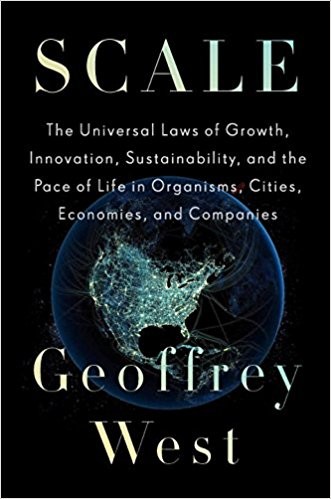
Scale introduces a single, decisive shift in how to think about diverse systems: rather than locating the essential differences between organisms, cities, and organizations in their material particulars, it treats them as instances of a common set of quantitative relationships. Geoffrey West moves the question away from surface diversity and toward the deeper architecture that produces similar patterns of growth, pace, and collapse across scales. The claim is not that everything is identical, but that a small number of structural regularities—measurable, often power-law relationships—organize how resources, activity, and information flow through living and social systems. Seen through that lens, very different systems reveal a shared grammar of movement and constraint.
The central mechanism West foregrounds is network geometry: branching, hierarchical, and space-filling distribution systems that shape how inputs reach nodes and how outputs recombine. In organisms, the geometry of circulatory and respiratory networks explains how metabolism scales with size; in cities, patterns of streets, social ties, and infrastructure mediate interactions that produce superlinear returns in innovation and economic activity. Organizations and firms inhabit similar constraint spaces but respond differently because their ‘‘networks’’—markets, managerial hierarchies, information channels—are mutable in ways that biological networks are not. The deeper implication is that scaling exponents are not decorative statistics; they are signals of underlying organizational structure and the trade-offs that structure enforces between efficiency, growth, and fragility.
This reframing changes the question from ‘‘How does this particular system behave?’’ to ‘‘What network architecture and flow rules generate these observed regularities?’’ That shift is consequential for knowledge systems and temporal intelligence. Rather than treating variance as noise to be eliminated, Scale suggests variance often encodes the operating constraints of a system: sublinear scaling indicates economies of scale and constraints on per-unit resource use; superlinear scaling signals increasing returns, acceleration, and amplified returns to interaction. Those signals matter for information architecture because they point to where attention should be allocated—toward bottlenecks that set fundamental limits, toward hubs that concentrate risk and innovation, and toward the rhythms at which learning must occur to adapt successfully.
Seen through a systems lens, the book reframes organizational questions of longevity and renewal. Biological scaling implies unavoidable trade-offs: larger organisms gain energetic efficiencies but live slower lives; cities seem to gain vitality and innovation as they grow but also accumulate stresses that require continuous reinvention. Corporations, in this view, are neither purely biological nor purely urban; they display organizational aging and death because their forms of connectivity, incentive, and knowledge flow tend to ossify or become misaligned with changing environments. The lesson for designers of knowledge environments is not a recipe but an orientation: attend to how networks amplify signals, where feedback loops inject path dependence, and which structures preserve adaptability versus locking in brittle efficiencies.
The book’s contribution to the Knowledge Flow library is methodological and epistemic. Methodological because it supplies an analytic lens—scaling relations and the network geometries that produce them—that can be applied across domains of organizational intelligence, information architecture, and temporal strategy. Epistemic because it invites a change in judgment about explanatory scope: regularities at aggregate levels can reveal constraints that individual-level models miss, and those constraints should inform how information systems are organized, how metrics are interpreted, and how interventions are timed. Rather than prescribing tactics, Scale supplies a taxonomy of signals and trade-offs that helps make complexity navigable.
Scale is careful about limits. The regularities it highlights do not remove the need for contextual judgment; they coexist with contingency, culture, and politics. The book’s value to a knowledge-focused library lies in its capacity to amplify curiosity about structure: it shows which patterns merit closer sensing, which growth dynamics require institutional learning, and which infrastructural changes will rebalance flows of energy and information. In that way it complements procedural and ethnographic accounts of organizations by supplying a cross-scale grammar for anticipating pressures and seeing when local optimizations collide with systemic constraints.
Why this belongs here
Scale belongs in the Knowledge Flow library because it offers a durable, cross-cutting frame for thinking about how information, resources, and activity circulate in living and social systems. It gives curators of knowledge environments a set of interpretable signals—scaling exponents, bottleneck geometries, and feedback rhythms—that help translate empirical patterns into governance and design questions.
The book functions as an orienting instrument: it broadens inquiry from isolated problems to their embedding in networked architectures, and it makes visible the trade-offs between efficiency, innovation, and longevity that matter for managing knowledge flows. For a library devoted to patterns, temporal intelligence, and organizational learning, Scale supplies both a vocabulary and a set of diagnostic motifs that enrich the practice of anticipating and shaping systemic behavior.