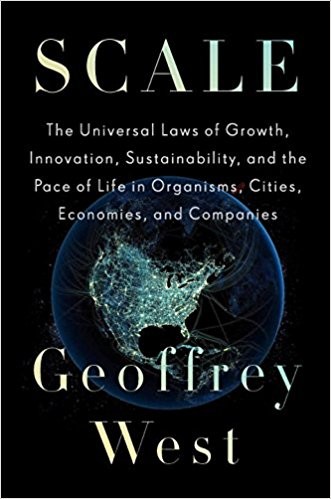

Geoffrey West’s central intellectual contribution is the systematic demonstration that scale—how big something is—fundamentally structures rates, lifespans, resource needs, and innovation across very different kinds of systems. Beginning with bacterial and animal metabolism and extending through cities and corporations, West and his collaborators uncovered reproducible quantitative relationships: many biological rates follow power-law dependences on mass (notably metabolic rate scaling roughly with mass to the three-quarters power), while many measures of urban activity (income, patents, crime) grow faster than population size, typically with exponents a bit above one. Those empirical regularities are not presented as trivia; West uses them to argue for underlying network constraints and geometry that explain why the same kinds of mathematical forms recur across domains.
Seen through this lens, size is not merely a descriptive statistic but a structural condition that channels processes. In organisms, constraints of nutrient delivery networks and surface-area-to-volume considerations impose predictable trade-offs between energy use, growth, and longevity. In cities, dense social and infrastructural networks amplify interaction rates—producing superlinear growth in creativity and economic output—while also creating accelerating demands on infrastructure and resources. West’s approach reframes questions about efficiency and fragility: growth brings predictable gains in productivity and connectivity, but it also carries structural stresses that can limit longevity or require continuous reinvention.
Rather than treating these patterns as domain-specific curiosities, West connects them to a small set of mechanistic ideas: fractal-like distribution networks, optimization under physical constraints, and the role of interaction networks in amplifying signals. The deeper implication is that many disparate systems—cells, mammals, cities, firms—are governed by similar trade-offs between throughput, maintenance, and structure. That commonality turns scale into a diagnostic and a design variable: knowing how rates change with size lets one anticipate resource needs, potential points of failure, and the kinds of innovation required to sustain growth.
West’s contribution changes the central question one asks about growth and organization. Instead of asking only how to accelerate output, his work asks what structural forms and flows are necessary to support different kinds of growth sustainably. The mathematical regularities he documents make visible the costs of interaction density (infrastructure, energy, waste) and the benefits (innovation, economic output), and they foreground time—how pace and longevity shift with scale. Those trade-offs are essential for thinking about organizational design, urban planning, and the long-term viability of knowledge ecosystems.
West’s methods also matter for Knowledge Flow: he brings tools from statistical physics and network science to empirical problems about information, interaction, and infrastructure. By treating cities and organizations as living networks with measurable flows, his work supplies models for how signals propagate, how bottlenecks emerge, and how structure conditions the speed and diversity of exchange. This systems-oriented perspective makes it possible to move beyond anecdote toward quantitative reasoning about how knowledge circulates and mutates in different habitats.
Relevance to Knowledge Flow
West’s work offers a concrete way to connect the physical architecture of a knowledge environment to its informational and creative outcomes. If knowledge flow depends on interaction density, connectivity patterns, and the capacity of supporting infrastructure, then the scaling relationships West identifies become predictive tools: they estimate how rates of idea generation, collaboration, and diffusion will rise or fall as communities grow or shrink. That supports a clearer framing of questions about how to configure spaces, both physical and digital, to balance productivity with resilience.
His emphasis on network geometry and delivery constraints supplies a language for diagnosing bottlenecks in knowledge ecosystems. Whether the system is a research institution, a city-wide innovation cluster, or a distributed online platform, the same tensions—between accelerating returns from increased interactions and rising costs of maintenance and coordination—recur. West’s models make explicit the trade-offs between speed, diversity, and sustainability that shape long-term knowledge flow.
Furthermore, the cross-domain regularities strengthen comparative sensemaking: patterns observed in biological networks provide hypotheses for social and informational networks, and vice versa. That comparative move is central to Knowledge Flow’s interest in transferable principles—how insights about infrastructure, redundancy, and interaction scale can guide design decisions across contexts.
Finally, West’s framing highlights temporal dynamics—how growth trajectories influence the lifecycle of organizations and cities. For Knowledge Flow, time matters: rhythms of innovation, turnover, and institutional aging affect how knowledge accumulates and moves. West’s scaling perspective encourages attention to these temporal contours when designing knowledge-rich environments.
Why this belongs here
West’s research belongs in the Knowledge Flow library because it furnishes a robust, quantitative lens for understanding how structural features determine informational outcomes. The library collects ideas that clarify how knowledge circulates in complex environments; West supplies a set of scalable relationships and mechanistic explanations that translate structure into expectation. His work helps the library’s orientation toward systems: it grounds conversations about design, policy, and organization in measurable constraints.
Including West also broadens the library’s comparative toolkit. His cross-domain approach exemplifies how patterns discovered in one habitat (biological organisms) can illuminate another (cities, firms), supporting the library’s interest in transferable principles. Finally, West’s focus on trade-offs—between productivity and sustainability, density and fragility—aligns with the library’s concern for long-term health of knowledge ecosystems, making his ideas a durable resource for thinking about both immediate flows and enduring conditions.