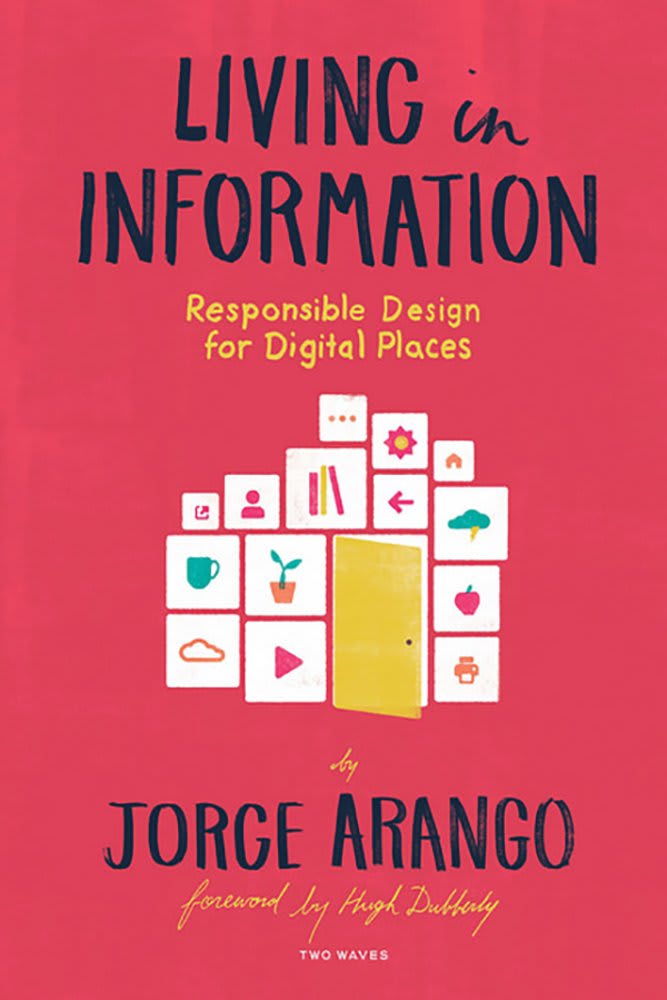
Living in Information draws on architecture to reframe how we design digital environments—not as tools or interfaces, but as places people inhabit. These are the spaces where critical parts of life now unfold: where we learn, make decisions, build relationships, and form understanding.
Yet most of these environments were not designed to support those activities. They are shaped instead by incentives that prioritize attention capture, engagement metrics, and monetization, often at the expense of clarity, coherence, and human need.
By treating information as something spatial and structural, the book invites a different set of design questions.
- What does it mean to create an environment that supports orientation rather than confusion?
- Continuity rather than fragmentation?
- Care rather than extraction?
This shift moves the work from arranging content or optimizing flows to shaping the conditions in which people can think, navigate, and act with intention. Information architecture becomes less about labeling and hierarchy, and more about inhabitable structure—places that make sense while you are inside them.
At its core, Living in Information is about responsibility. If digital systems are environments, then their design directly shapes human experience: what is visible, what is connected, what is possible to understand. The book challenges the assumption that usability or efficiency is enough, and instead points toward a more human-centered standard—systems that support meaning, not just interaction.
Why this belongs here
Living in Information names a structural truth that underpins Knowledge Flow: we do not simply use information systems—we live within them.
Knowledge Flow is concerned with how those environments enable or constrain understanding over time. When systems are designed for attention rather than sensemaking, they fragment knowledge, disconnect context, and erode continuity. What looks like engagement is often disorientation.
This work points toward a different design stance: shaping information environments that support orientation, coherence, and the ability to think. Not just to find or consume information, but to make meaning within it.