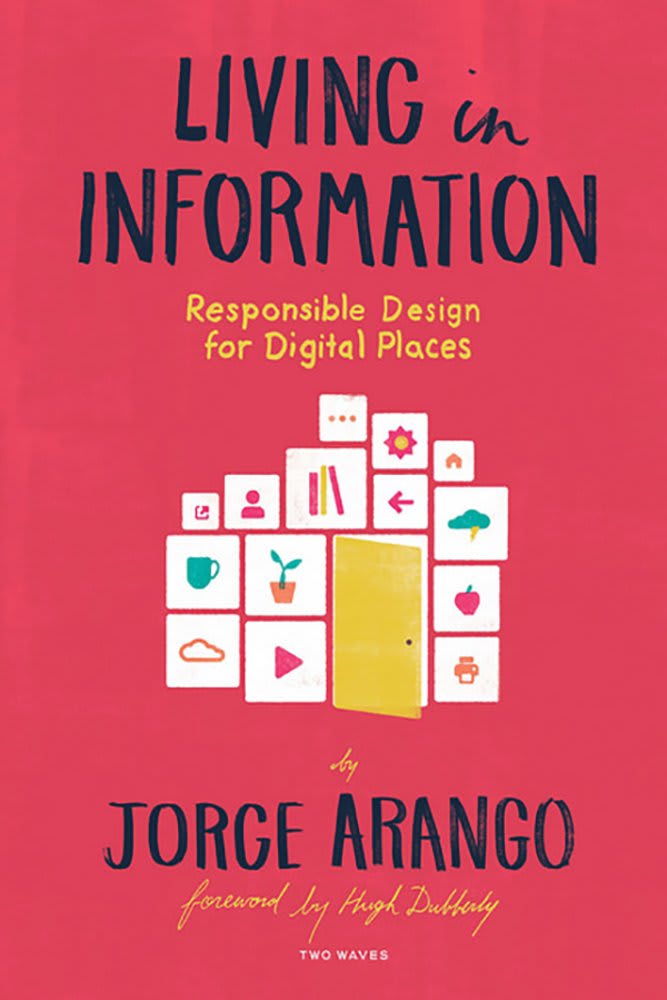

Jorge Arango is an information architect and design thinker whose work focuses on how people orient themselves within complex information environments. Trained as an architect, he brings a spatial and structural sensibility to digital systems—treating websites and applications not as collections of pages, but as environments people must navigate, understand, and inhabit.
Since encountering the early web in the mid-1990s, Arango has worked across a wide range of contexts—from nonprofits to large enterprises—helping organizations design systems that support clarity and usability at scale. He is co-author of Information Architecture: For the Web and Beyond, one of the foundational texts in the field, and a longtime leader in the information architecture community.
His work consistently emphasizes orientation: the ability for people to know where they are, what they can do, and how things relate. Rather than focusing solely on structure or taxonomy, Arango explores how design shapes understanding over time—how environments either support or undermine a person’s ability to make sense of what they encounter.
Relevance to Knowledge Flow
Arango’s work makes visible a core concern of Knowledge Flow: the relationship between structure and understanding.
Knowledge systems do not fail only because they lack information—they fail because people cannot orient within them. Without clear relationships, continuity, and context, even well-structured systems become confusing and unusable.
By framing information architecture as the design of environments for orientation, Arango points toward a deeper responsibility: not just organizing content, but enabling people to make sense of it. This is foundational to knowledge flow—where meaning emerges through navigation, connection, and use over time.