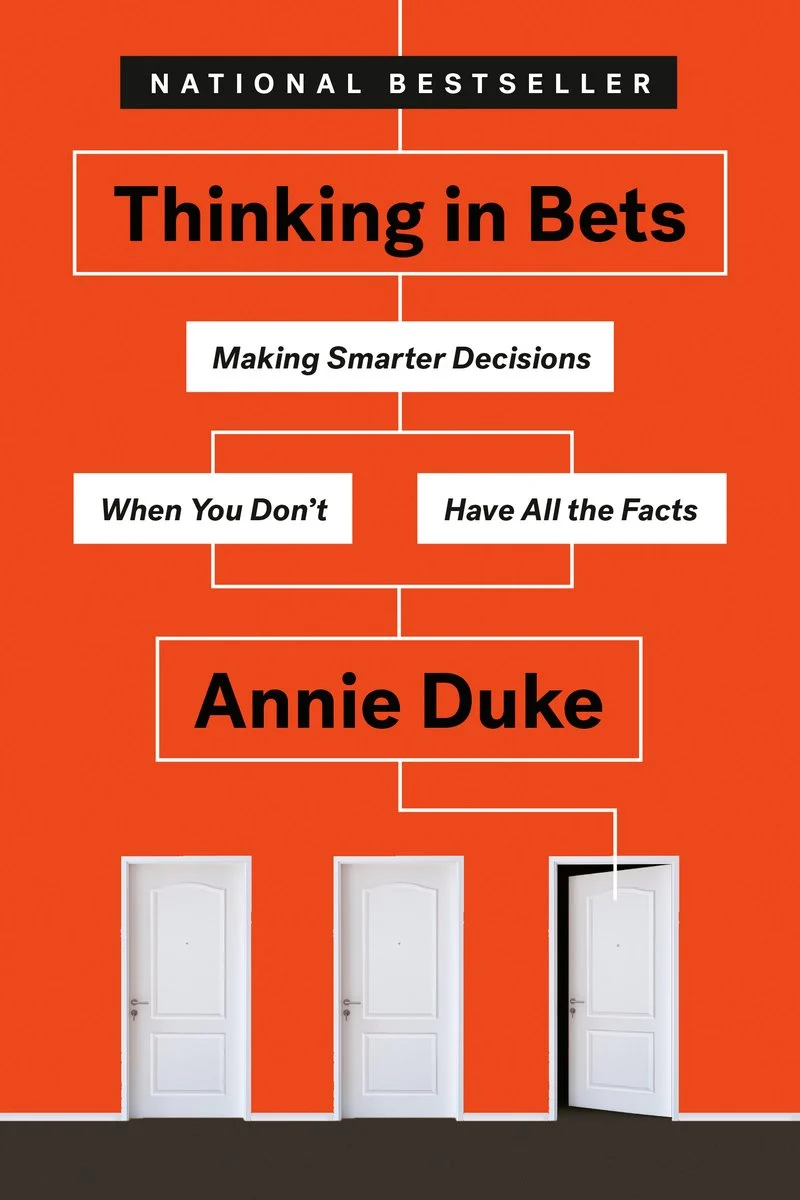
In Thinking in Bets, Annie Duke examines how people make decisions in environments where outcomes are uncertain, information is incomplete, and luck plays a significant role.
Drawing from professional poker, behavioral psychology, and decision science, Duke argues that people often confuse outcome quality with decision quality. A good decision can lead to failure; a poor decision can occasionally succeed. This misunderstanding creates distorted learning loops that reinforce overconfidence, hindsight bias, and simplistic narratives about success and failure.
The book advocates probabilistic thinking: approaching beliefs, interpretations, and choices as evolving estimates rather than fixed certainties. Duke encourages readers to continually recalibrate their confidence levels, test assumptions, seek disconfirming evidence, and remain open to updating their thinking as reality unfolds.
Rather than pursuing impossible certainty, Thinking in Bets frames intelligent decision-making as an ongoing process of learning, adaptation, and reflective judgment under ambiguity.
Why this belongs here
Thinking in Bets reinforces one of the central ideas of Knowledge Flow: intelligence is not certainty.
Knowledge systems become fragile when people protect conclusions instead of refining understanding through feedback and reflection. Duke’s probabilistic approach encourages epistemic humility, adaptive learning, and the ability to separate ego from interpretation.
The book also highlights the importance of healthy feedback loops and reflective practice within complex systems. Knowledge Flow depends not on always being right, but on becoming better at learning from uncertainty over time.