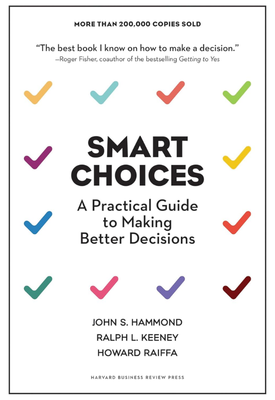
Many poor decisions begin before alternatives are compared. People frame the wrong problem, overlook objectives, rush to favorite solutions, or fail to examine tradeoffs clearly.
Smart Choices offers a disciplined alternative.
The authors introduce a practical sequence: define the problem, clarify objectives, generate alternatives, understand consequences, make tradeoffs, and account for uncertainty. Its strength is that it makes decision quality visible.
Instead of treating decisions as moments of authority, the book treats them as structured reasoning processes. This matters for groups because disagreement often hides at the level of objectives and assumptions.
By making those elements explicit, teams can improve both the decision and the legitimacy of the process.
Why this belongs here
Knowledge Flow depends on decisions that remain connected to reasoning. Smart Choices belongs here because it provides a governance pattern for transforming information, values, and uncertainty into accountable action.