Social systems are difficult to understand because they are adaptive. People learn, respond, imitate, anticipate, and change the environment they inhabit.
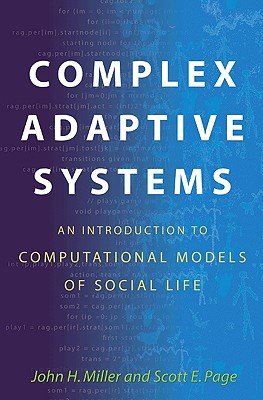
Miller and Page introduce complex adaptive systems as a way to study these dynamics. The book emphasizes agent-based modeling.
Rather than assuming aggregate behavior from the top down, researchers can explore how local interactions produce emergent patterns.
This approach reveals why simple rules can create complex outcomes. It also shows why interventions may produce unintended consequences.
The book is especially useful for understanding organizations as adaptive systems rather than machines.
Prediction becomes difficult, but pattern exploration becomes possible.Why this belongs here: Knowledge Flow depends on understanding how local interactions create system behavior. This book belongs here because it provides a modeling lens for distributed intelligence, adaptation, and emergence.
Why this belongs here
Knowledge Flow depends on understanding how local interactions create system behavior. This book belongs here because it provides a modeling lens for distributed intelligence, adaptation, and emergence.