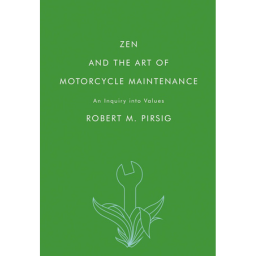
Zen and the Art of Motorcycle Maintenance follows a father and son traveling by motorcycle across the American West, interwoven with reflective “Chautauquas” in which the narrator explores philosophy, science, sanity, and meaning. Through encounters with friends, landscapes, and mechanical problems, the book critiques the modern divide between classical rationalism (logic, analysis, technology) and romanticism (intuition, aesthetics, feeling), arguing that this split impoverishes both our work and our lives.
At the center of the book is the elusive concept of Quality—a pre-intellectual, experiential reality that precedes subject–object distinctions and underlies both good engineering and good living. By treating motorcycle maintenance as a form of care, attention, and ethical engagement rather than mere technical labor, Pirsig reframes technology as something that can be deeply human rather than alienating. The narrative ultimately becomes both a philosophical inquiry and a personal reckoning with identity, mental illness, and the cost of denying coherence between how we think, build, and live.
Why this belongs here
Zen and the Art of Motorcycle Maintenance exposes a fracture that shows up in nearly every knowledge system: the separation between formal reasoning and lived experience.
Knowledge Flow is concerned with what happens after that split—when systems privilege structure over sensemaking, outputs over understanding, and correctness over coherence. Pirsig’s concept of Quality points to a different starting place: meaning emerges through engaged attention, not abstract models alone.
This is why many systems feel technically sound but experientially hollow. They are missing the very thing that makes knowledge usable.