
The Pain Train
Chances are: You have arrived here on the same train I rode in on.
Over the last 20+ years, in my “free” time, I’ve given talks at events, taught workshops and courses. More recently, I’ve been writing books. There is one reason I do this: to help others feel less alone while riding on the Pain Train.
Chances are you know the Pain Train.
You’ve solved a difficult problem then worked hard to communicate your ideas. You’ve gathered feedback from others, made slides or protypes, bridged gaps between team silos, glued opposing perspectives, herded cats.
The Product Manager says there’s no time to do it “your way”. The CXO says there’s no budget for anything but Current Buzzwork or Toolset. That Guy, the one who knows everything (or so he believes), says it won’t work. The engineers say it’s not concrete enough.
An “easy” answer get adopted instead – a “solution” that will make the problem worse (in the long run).
The fix doesn’t hold, the problem recurs. And the cycle begins again.
Or, eventually, your recommendation gets adopted. But by then, nobody remembers it was your idea. Nobody remembers dragging you through the mud for months only to arrive at the same conclusion.
Besides, you are already pushing the next rock up the next hill. Hoping that this time, it won’t roll back down (and crush you).
Welcome to The Pain Train. Where the exhausting friction of turning information into shared meaning, decisions, and action makes you question every one of your life choices.
Zen and the Art of Knowledge Flow
Early in my career, I didn’t have a name for the Pain Train. I didn’t recognize the ways a thinking system stays stuck in its own loops. Both wanting and resisting change.
Until I experienced different organizations “transforming”, then reconstructing the same problems, using trendy new lingo. Often, the new problems were worse than old problems. Well meaning people steered the ship of change straight into an iceberg. Everyone was surprised when it sunk.
Again and again, despite efforts to do things differently.
At first, I believed that if I worked harder, I’d break on through to the other side.
Hard work taught me a lot. Primarily, It taught me that the endless cycle of fixing the same problems again and again, wasn’t a bug, it was a feature.
If a factory is torn down but the rationality which produced it is left standing, then that rationality will simply produce another factory.
— Robert Pirsig, Zen and the Art of Motorcycle Maintenance
My efforting was often misplaced.
Transforming rationality isn’t done with LLMs, Kubernetes, or Product Strategies.
Because rationality isn’t a toolset we apply to problems. It’s how we craft what we call “reality”, how we shape what we believe, how we justify it, and how we choose to act — moment by moment.
The true system, the real system, is our present construction of systematic thought itself, rationality itself.
— Robert Pirsig, Zen and the Art of Motorcycle Maintenance
This is what I mean by knowledge.
Not facts. Not winning at Jeopardy!. Not Wikipedia, whiteboard tests, or scientific theories — though all of those require shaping meaning and insight.
Knowledge is not something we own, store in a database or retrieve via artificial intelligence.
Knowledge is something we experience. We practice and refine it, together, in context, amidst uncertainty.
Through this shaping, again and again, we generate the systems we live and work within.
At first, this really blew my mind: I can see the organization structure in every software system. Today, I know it in my bones. I can model the org or model the software system — it doesn’t matter, the two will look very similar.
I love this snarky rendition ….
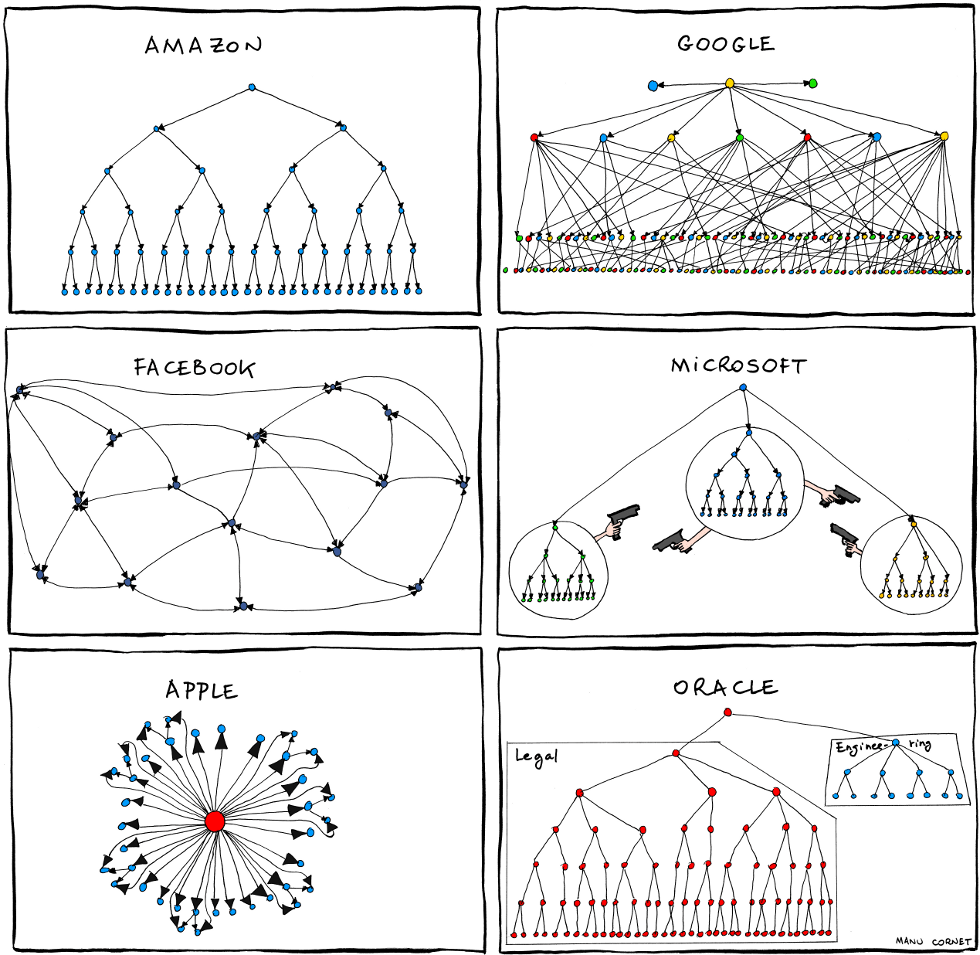
We have had a name for this since 1967.
Any organization that designs a system (defined broadly) will produce a design whose structure is a copy of the organization’s communication structure. — Conway’s Law
The flow of knowledge — or its absence — designs every system we build.
You know what knowledge is because you experience it, every day. Flowing through everything you design, synthesize, shape, focus on, share, and deliver. It’s what you pay attention to and everything you ignore.
Every decision you make draws from the flow of knowledge. Like water, its shape depends on context, purpose, and perspective.
If you were hoping for a set of concrete solutions to generalized problems … you won’t find them here.
You will find the practices and pathways that increase your capacity to address challenges in more satisfying, rational, and impactful way.
I wrote Learning Systems Thinking to help other software professionals understand recurring patterns in systems we build and experience. As we uncovered more and more common patterns, we realized a deeper problem … understanding the system wasn’t enough to change it.
We could name the leverage points. Map the structures. Identify the feedback loops. Even agree cross functionally on what was happening. And still — the same patterns reappeared.
Because …
If the architecture of the system and the architecture of the organization are at odds, the architecture of the organization wins. — Ruth Malan
When we change delivery processes or decisions, but not the interlocking relationships — the infrastructure over which they flow — we produce the same outcomes again and again.
The system wasn’t just “out there.” It was being generated, continuously, by us. Moment by moment. Decision by decision. Artifact by artifact.
We need to intervene at their genesis — not by restructuring systems, but by transforming how concepts and processes come into being.
This book explores practices that help teams, software, and ideas change without fragmenting into silos, pipelines, and reporting structures.
Continuously. Decision by decision. Artifact by artifact.
Getting Your Hands Dirty
Here’s the bad news: certainty is impossible.
Certainty is parasitic — it feeds on knowledge while slowly killing it. The more you struggle to be certain … the more your mind closes to knowledge.
Here’s the good news: this is joyful liberation. You can arrive at conclusions and take sound action in the midst of uncertainty.
As a matter of fact, you already do this every day. Not by performing knowledge acts — showing how much you know or how fast you can produce, valuable as those things may be.
You do it by shaping artifacts.
I know. This is a pivotal moment in our relationship.
You might hate what comes to mind right now. Mabye you feel duped into reading a “write more documentation” book. It is not. Maybe you are thinking “I already have more than enough artifacts in your daily life, thank you very much”.
You’d be right about that last part.
Knowledge at rest has ceased to be knowledge.
When I say artifact, I probably do not mean what you think I mean. An artifact is any object made or modified by human beings that gives temporary form to concepts, structures, recommendations, diagnoses, decisions, actions, and more. Code is an artifact. So is a Slack post.
The conveyance is the least of my concerns. What matters here are three things: defeasibility, crafting, and systemic reasoning.
For our purposes, an artifact is defeasible — open to revision, valid objection, or simply becoming less relevant. Knowledge changes, as does everything else.
Artifacts are not knowledge. Their value lies in the crafting of them, and in what that crafting makes possible. At best, shared artifacts trigger, nourish, and support further insight. At worst, they are what we produce to feed a noisy system.
Using artifacts to shape rationality is a practice you never outgrow. Context, conclusions, and shared perspectives are always in motion. Making an artifact can reveal blind spots, point you in a better direction, surface a question you need answered, or simply give you enough distance to reshape your thinking.
Systemic reasoning, our core practice, is an artifact made up of three parts, whether or not those parts are explicit:
- A conclusion or assertion: what we believe we know.
- The reasons that justify it: what convinced us, and how we reached that conclusion.
- Context: the circumstances that exist right now and inform that conclusion.
Sound simple?
It is not.
If you have never done this before, prepare to be surprised by how terrible you are at crafting systemic reasoning.
If you have done it before, you already know how terrible you are at it. The better you get, the more clearly you see how much you can improve.
That’s the fun part. (No, really, it is.)
Knowledge work — and designing its flow — is really, really difficult. If it were easy, the world would be a very different place.
Chances are, if you are reading this book, you enjoy doing difficult things.
This is a mountain we can enjoy climbing together.
Activity: Consider this
Reading is one of life’s great pleasures. The experience of consuming other people’s thinking. That experience, my new reader companion, is insufficient for learning knowledge flow skills.
Mo real change can happen without transforming your own thinking. I like my thinking, and I hope you enjoy it too. But what matters most is how well (or not) it supports your work.
You might love the ideas you find here. You’ll likely hate at least one of them. Regardless, you’re in flow with me. We are doing the work together, asynchronously.
As Beetlejuice said, “You’ve got to work with me here.”
Throughout the book, there are “Consider this” prompts.
Write your answers. (Or ask yourself a different question, that’s fine too.) Pay attention to your experiences.
You can share them but you don’t have to. Planting the seeds of insight is enough. They’ll grow when the time is ripe.
Here is your first one:
The Journey Ahead
There are as many ways to explore knowledge flow as there are ideas.
Our primary journey will be along Six Spiral Paths that move us away from the Six Dominant Delusions (of Unusual Size) towards the Six Inconceivable Truths. (Warning: there will be snarky jokes and movie quotes on this journey.)
You’ll be practicing. Making artifacts, learning skills, opening to new concepts, shifting your perspective. No doubt you’ll disagree with me. And you’ll practice expressing that disagreement in ways that generate better ideas.
Here’s a peek at what’s ahead.
First we’ll learn the core skills and understand knowledge infrastructure.
Then, we’ll take a journey. Each path moves us from a familiar delusion to a more generative truth and gives us practices to walk the distance between them.
- Temporal Navigation
- Static knowledge → knowledge shaped by time
- Navigate currents, not schedules
- Relational Coherence
- Knowledge as hierarchy → knowledge as reciprocity
- Generate meaning together
- The Architecture of Meaning
- Execution → emergence
- Build structures where meaning compounds
- Facilitating Intelligence
- Command and control → distributed intelligence
- Steward decisions, don’t dictate them
- Engineering Learning
- Delivery → learning
- Design loops that adapt
- Cognitive Ecologies
- Pure rationality → many ways of knowing
- Integrate diverse thinking
This journey is fraught. There is no “easy way” to get from here to there.
Albert Camus said, “You have to imagine Sisyphus happy.” Pushing the boulder becomes freedom, he asks us to believe.
Pishposh.
We made these systems. The Pain Train, the boulder, Jira, the factories. Humans invented them. And too often, they work against knowledge.
I want to do knowledge work.
You might ask me, like James did when deciding whether to join Men in Black, “Is it worth it?”
Like Agent K, I can only say, “Oh yeah, it’s worth it … If you are strong enough.”
If you are strong enough to step off the Pain Train. If you’re strong enough to:
- Focus on the framing the right questions, rather than getting the right answers
- Examine your current beliefs about knowledge
- Walk the paths that get you from here to there?
I’m here with you, looking forward to our journey together.
You are still reading … you are ready.
Let’s begin.
Activity Two: Build Your Home
Throughout this book, you’ll build a knowledge repository. Forget everything you think you know about what knowledge, repository, or even creating means. Chances are, your definitions will change.
To begin, set up a practice area — your experimental home. It can live anywhere you like, using any tool you prefer. I’m so not the boss of you. But here’s one constraint that will help you down the road:
Use Coda.
That’s it. Create an account and set up a few starter tables.
Visit the Knowledge Studio
Okay, maybe that’s a bit too constrained. Other good tools include Obsidian, Notion, Airtable, Heptabase, Google Sheets, Figma, or Miro (if you’re visually inclined).
You can Luddite this and use a notebook (or a reMarkable), but capturing links will be harder. If you still work by hand, I'm sure you’re not averse to a little sweat.
Once you’ve built your home, come back and continue your journey. Beginning with the core compentencies.