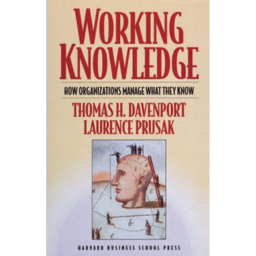
In Working Knowledge, Thomas H. Davenport and Larry Prusak dismantle the assumption that better databases, documents, or IT systems are sufficient to make organizations smarter. They draw a clear and influential distinction between data, information, and knowledge, arguing that knowledge is inherently human, contextual, and action-oriented. Through case studies and practical analysis, the book demonstrates that knowledge cannot simply be “managed” as an object—it must be supported through trust, shared practices, and environments that encourage learning, judgment, and reuse.
The book reframes organizational performance around knowledge flow: how insight is created, shared, applied, and sustained over time. Davenport and Prusak show that companies fail not because they lack information, but because they misunderstand how knowledge emerges and compounds within real work. By treating knowledge as a productive force shaped by culture, incentives, and relationships, Working Knowledge laid the foundation for modern thinking on knowledge-centered strategy, organizational learning, and long-term adaptive capability.