Now we begin our journey into the realm of knowledge flow. Where we will:
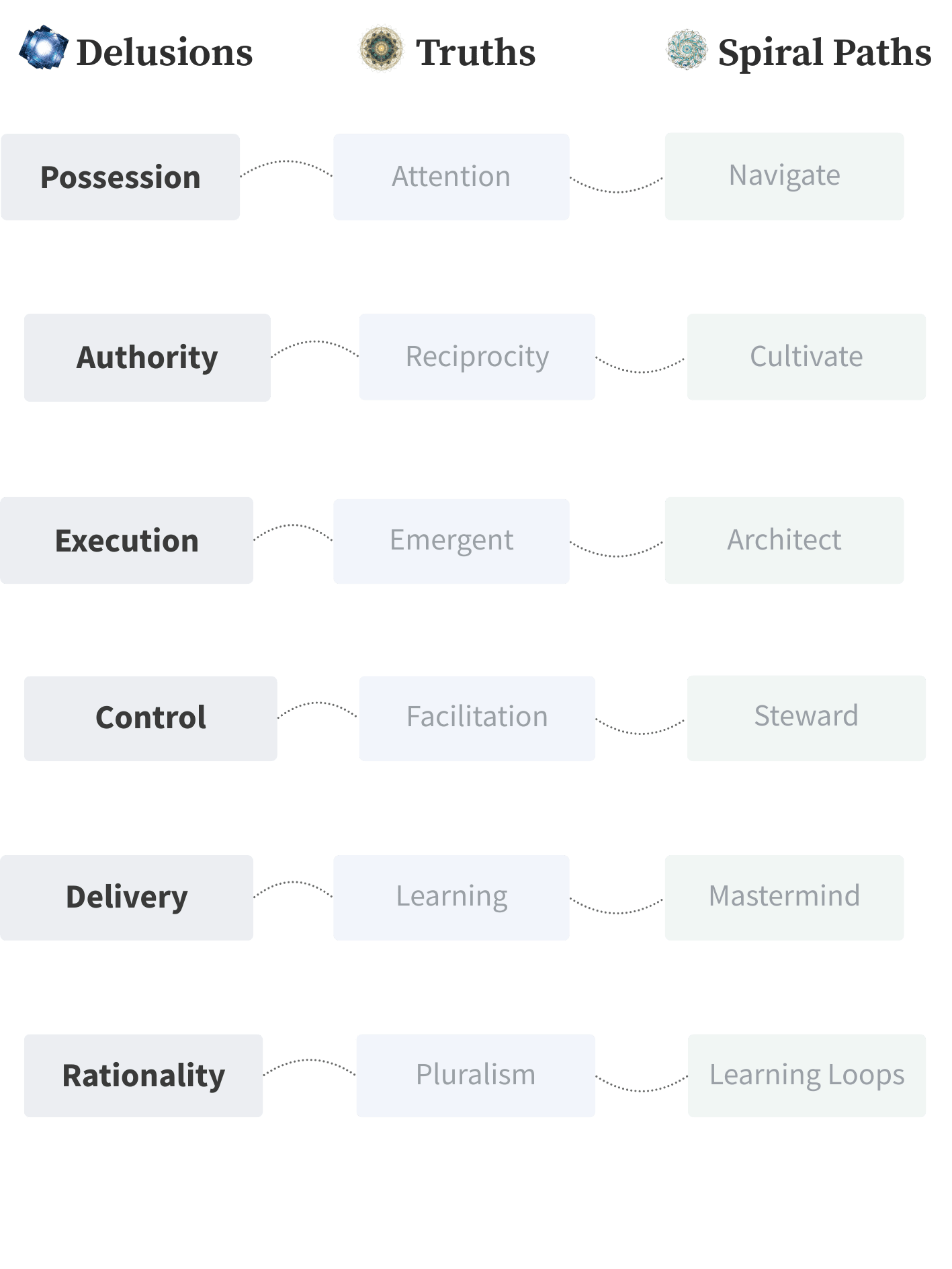
First, we’ll explore the Six Delusions of Unusual Size. Then, the Six Inconceivable Truths. We’ll leave the fireswamp of delusions and discover the truths, by walking the Spiral Paths. Paths of practices that, over time, generate knowledge flow.
Here is a brief summary of the six Delusions, Truths, and Paths.
1. Temporal Navigation

Delusion: Knowledge is a Static Possession
We mistake knowledge for static possessions: documentation, data warehouses, and the facts we store in our heads. But knowledge isn’t something you own; it’s something you do: interpretation, connection, shared context, and the ability to act in new ways. A living process — shaped by time, attention, and relationship. When information doesn’t flow, we lose the ability to learn, adapt, or make meaning together.
Truth: Knowledge is Shaped by Time, Energy, and Attention
Knowledge emerges as people invest attention and act on feedback in context. Time isn’t linear — events create loops, delays, accelerations, and cascades that no plan can fully predict. This truth invites you to stop managing time as a schedule and start navigating it as a living medium.
Spiral Path: Navigating Temporal Currents
Knowledge flow doesn’t move on a straight line or a tidy Gantt chart. It moves like currents: fast here, slow there, colliding, looping back, rushing forward at the moment you least expect. To navigate temporal currents is to stop treating time as a container you control, and start treating it as a living medium you move through.
Practices here don’t try to “manage” time, but to develop real-time sensemaking.
When systems are designed this way, insight arrives when it matters, not just when it’s convenient. Teams stop drowning in stale plans and start flowing with the living pulse of events.
2. Relational Coherence
Delusion: Knowledge is Hierarchical Authority
We mistake knowledge for rank, a social reinforcement of reasoning shortcuts. Knowing is handed down through a linear hierarchy, where some people know (without justification) and others don’t know (even when they do). Knowledge emerges through reciprocity, not rank. When people, teams, and tools exchange perspective, context, and care, they create meaning that no one could generate alone.
Truth: Knowledge is Relational Reciprocity
Knowledge doesn’t trickle down; it moves laterally through people who understand why their actions matter and how they connect to others. Relational reciprocity integrates tacit know-how. Insight moves across roles — strategy and implementation inform each other. Without reciprocity, work falls into the gaps, coherence collapses, and knowledge work quietly drains away.
Spiral Path: Cultivating Coherence
In knowledge systems, cultivating coherence means meaning can travel across boundaries without being flattened or lost. It’s not uniformity — it’s resonance. Like a jazz ensemble: each player has freedom, but their contributions hang together as a living whole. It’s noticing when relationships fray, when timing gets out of sync, when concepts splinter — and weaving them back into sensible alignment.
Coherence generates resilience: because when the whole is coherent, a disruption in one part doesn’t collapse the system — it rebalances.
3. The Architecture of Meaning

Delusion: Knowledge is Efficiency of Execution
Most organizations still believe that efficiency and throughput are the ultimate markers of organizational intelligence. This worldview reduces knowledge to compliance with tasks and timelines, holdovers from industrialization. It produces brittle systems that optimize for immediate execution but erode adaptability, learning, and long-term value. And ignores reflection, abstraction, and emergence — core qualities that produce innovation.
Truth: Knowledge is Emergent Meaning
Meaning does not emerge from speed or compliance, efficient execution of predefined tasks. It emerges from interaction — people, tools, context, and feedback shaping insight together. Shared meaning allows decisions and actions to remain coherent across teams, time, and tools. Without structures that help people connect — shared vocabularies, artifacts, and practices — knowledge fragments rather than compounds.
Spiral Path: Architecting Emergent Meaning
Meaning moves over an organizational infrastructure. This structure is not made of rigid blueprints, but connective practices — ontologies, repositories, shared vocabularies, and pattern libraries — that let execution move with coherence. This path builds the cumulative architecture of meaning — replacing endless re-invention that makes knowledge brittle.
4. Facilitating Intelligence

Delusion: Knowledge Leadership is Command and Control
When we envision progress as a linear stairway, we climb ever upwards toward greater control, mistaking dominance for leadership. Organizations suppress signals reveal the impact we leave behind. Thus missing the truth of all systems: we are also the architects of our collective self-destruction. Real knowledge leadership means stewarding adaptive systems that learn, respond, and evolve.
Truth: Knowledge Leadership is Facilitation
Command-and-control leadership compresses what an organization can know into the limits of a few minds, blocking learning and emergence. Knowledge leadership works differently: it facilitates decision-making by distributing information, sensemaking, and authority without losing coherence. Growth comes not from simply telling people what to do, but from designing intelligent sociotechnical systems.
Spiral Path: Stewarding Distributed Decisions
Stewardship is designing and legitimizing processes that distribute authority without losing coherence. Leaders ensure transparency, fairness, and perspective weaving. Instead of dominance, control and gatekeeping. Decision-making becomes the practice of facilitation — keeping flow open, trust intact, and the system adaptive.
5. Engineering Learning

Delusion: Knowledge is Just Delivery
Most plans focus on deadlines, faster processes, on time and on budget. Delivery isn’t the end of knowledge flow—it’s the midpoint. Real learning happens after release, when reality pushes back and reveals what matters, what we missed, and what needs to change. Knowledge is engineered through continuous learning, not through faster pipelines.
Truth: Knowledge is Engineered Through Learning
Knowledge flow delivers by engineering the conditions that encourage adaptation. Engineer, in this sense, isn’t limited to writing code or building machines — it’s designing feedback loops, reflection spaces, and experiments that turn experience into evolution. Every role participates in engineering: leaders shape environments, designers shape experiences, teammates shape trust. When systems embed learning in their very structure, they don’t just survive change — they grow stronger through it.
Spiral Path: Designing Learning Loops
Learning doesn’t happen once and stick — it’s designed into organizational experiences. Designing these experiences is creating conditions where reflection, feedback, and experimentation are continuous. Instead of shipping knowledge like cargo, you design feedback architectures, retros, and experiments that turn experience into adaptation. Replacing linear approaches “plan → build → deliver,” with an evolving loop: notice → test → reframe → act.
6. Cognitive Ecologies

Delusion: Knowledge is Pure Rationality
The “hard vs soft skills” myth cripples organizational intelligence by elevating logic and data while dismissing intuition, emotion, embodiment, and relational insight. Human systems are cognitive ecologies—knowledge emerges only through diverse ways of knowing. Wisdom that can inform action is shared meaning, not simply analytical reasoning.
Truth: Knowledge is Many Ways of Knowing
When rational, linear thinking is treated as the only legitimate form of intelligence, organizations can’t learn and adapt. Real knowledge work integrates multiple cognitive modes — analytic reasoning, embodied intuition, collective sensemaking, and storytelling. When these modes become allies instead of competitors, systems generate insights and solutions that no single way of thinking could invent alone.
Spiral Path: Mastermind Cognitive Ecologies
Integrating multiple modes of thought (analytic, embodied, intuitive, relational) is not as easy as writing KPIs or adopting frameworks. But it pays off — in systems where different kinds of cognition work together to deliver something few competitors could possibly match.
Are you ready for the Fireswamp? Ready or not … let’s dive in.