
Belief is a wound that knowledge must heal. – Ursula Le Guin
The Tidal Wave
Throughout my career, I’ve had a recurring dream.
I am standing alone in an ocean-side cave, looking out at the watery expanse through the wide-mouthed opening. Stone walls drip moisture onto my clothes, sunlight bounces in.
And in the distance, a tidal wave is heading straight for me.
This is not a nightmare, I am not afraid. Instead, I am shouting at it. Telling it off. As if my vigilance it will make it halt.
That’s it — that’s the entire dream. Yelling at a tidal wave that never arrives but is always encroaching.
Perhaps you’ve felt that way in your daily worklife? Like you are shouting at forces you can not compel?
This dream arrives when I’ve managed to get off the Pain Train. When I don’t feel trapped in patterns that compel me to think and act in reinforcing ways.
But instead of doing something productive with my time, explore the world past the Fireswamp, I stand there yelling at world behind me, trying to make it stop.
This chapter gives you something productive to do instead.
I’m not literally yelling, by the way. I’m keeping my cool in meetings. Being socially savvy and helpful. But under the surface, a bubbling dissatisfaction is writhing.
“Gaslit” is what you feel when the epistemic infrastructure (the current flow of knowledge) makes you doubt your own perception of reality. The true Gaslight Masters are the Six Dominant Delusions (of Tidal Wave Size). They can become so big — The Notorious RBG can’t get a job as a lawyer.
The power of delusions comes from feeding them our attention. Investing our time, energy, and attention trying to manage them. Rather than building the system of support we actually need.
These Six Inconceivable Truths help you stop yelling at the tidal wave. That critical pause, shifts your attention so you can follow pathways towards where you want to be.
I no longer dream of tidal waves. I stopped believing that I must free others from the Matrix in order to be effective. Increasingly, I am more productive, and impactful, when I invest my time, energy and attention in generating knowledge flow.
And, in helping others to do the same.
The Six Inconceivable Truths
You keep using that word. I do not think it means what you think it means. – The Princess Bride
This chapter is orients us for the journey forward. The rest of this book will focus on all the ways we can express, experience, define, and even delight in these truths. First, we’ll get to know each other.
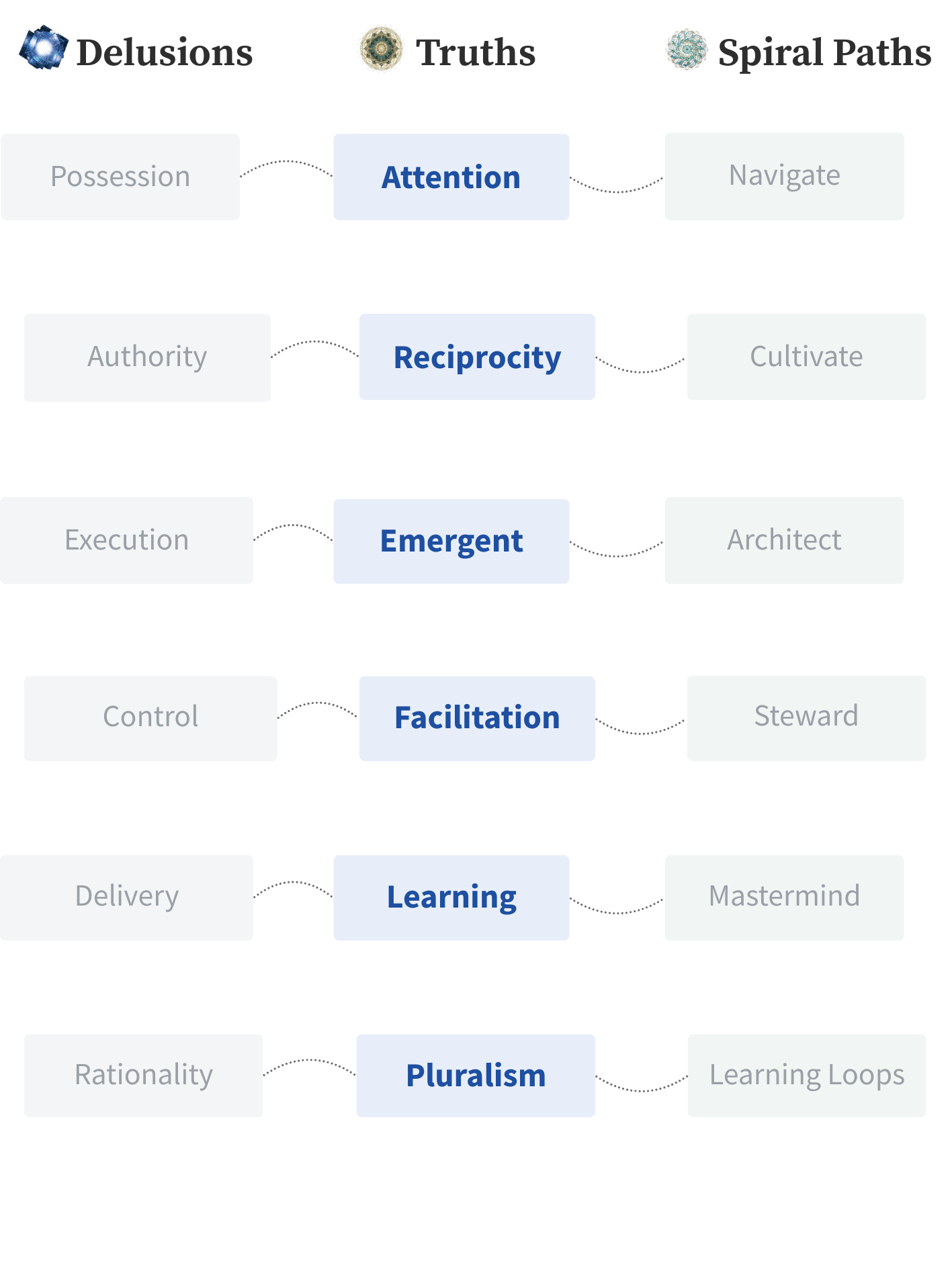
- Knowledge is Shaped by Time, Energy, and Attention
- Knowledge is Relational Reciprocity
- Knowledge is Emergent Meaning
- Knowledge Leadership is Facilitation
- Knowledge is Engineered Through Learning
- Knowledge is Many Ways of Knowing
While reading this chapter, don’t try to memorize any of it. Just get the feel, the rhythm, of what’s ahead. We’ll break each one down, go deeper, subsequent chapters.
You can take your time.
There is no binary world in which we eradicate delusion and live in truth. There is only a world where the delusions are right sized. Where they serve a knowledge system rather than strangle it.
How will you know when delusions are “right sized”, when there is balance? The Spiral Paths in the next chapter will help you begin to answer that question. For now, just know that we are heading in the right direction when we can re-architect how we invest our time, energy and attention — in ways that make sense in that circumstance.
The Six Inconceivable Truths are not a perfect framework. They do not address every challenge that every organization will ever face. They are signposts that point us away from the dominant delusions, towards smarter systems.
They are aspirational, not legally binding.
Don’t worry if you find these difficult to imagine at scale. “Yeah but, what about …?” We’ve been doing the same things in the same ways for a long time.
You are not deploying a new system or replacing the old one. You are just taking one step at a time.
One step at a time is enough to transform the world entire.
Knowledge is Shaped by Time, Energy, and Attention
Your focus determines your reality. — Qui-Gon Jinn, Star Wars: The Phantom Menace

Knowledge is not a Confluence page waiting to be discovered. Knowledge emerges as we invest our time, energy, and attention in meaning-directed practices and taking feedback-informed action.
Contrary to every Project Milestone Model ever, time is not a uniform, one-directional line. Decisions cause ripples. Actions trigger loops. A single event can trigger recurring decisions, new delays, unexpectedly reduced friction, emergencies, viral success, and cascading fire drills in a chaotic way.
Rather than managing time, controlling it with Gantt charts, we can adopt practices that treat time as a living medium we are moving through.
We cultivate temporal intelligence: the organizational capacity to design asyncronous systems.
We improve patterns rather than constantly patch. We adapt our processes so we can contribute meaningful responses to real-time events. Not one-size-fits-all responses, ones that fit the context.
For example, Async Event Response Design:
When a single significant event happens (e.g., the internet goes down, a big sale launches, changing shipping vendors) we can design an asynchronous response plan.
We don’t think of this as an emergency to control. Instead, we understand how every context is impacted. And what knowledge flow was missing at the time.
This understanding enables operational response patterns to shift, depending on what they experience. We encourage other parts of the system (software and teams) to consider impact and design ways to support each other.
Chances are, you have already designed temporal intelligence. Any feedback loop, including comments from peers and database queries, is an example.
The goal is to understand that these loops are nonlinear and unpredictable, and stop trying to make them otherwise. Therein lies the power to shape new outcomes.
Knowledge is Relational Reciprocity
None of us is as smart as all of us. — Woody, Toy Story

Knowledge doesn’t trickle down — it flows across systemic relationships: people, teams, and tools exchanging perspective and context.
Reciprocity means “how parts work together”. Reciprocity is a mechanism, triggering the recognition that parts of a system (teams, software) should work together.
It means, fundamentally, that we need to share our knowledge.
Well-designed reciprocity translates context across roles. For example, when I write code, I understand why the code matters to the people who rely on it. I’m not simply doing what I’m told, I’m acting on something I understand.
Reciprocity leverages tacit know‑how, the experience we get by doing. It integrates the hands-on insights we can’t easily explain.
For example, when I’m writing the code that delivers a new user experience, I discover ways to improve the “requirements” to increase the value of my work. I help the organization integrate technology expertise with business goals and human activities by integrating strategic ideas with implementation wisdom.
Without relational reciprocity, our time, energy, and attention fall into the gaps — between people, teams, software systems, roles, and points of view. Without it, we are wasting the money we pay for knowledge work. Like throwing it into the Grand Canyon rather than investing it.
Social processes and technology systems co-create each other. The epistemic infrastructure can co-create coherence and enable social and technical parts to act in harmony. It can also create blockers, gaps, silos and a firehose of unstructured information to scan. (I’m looking at you Slack channels.)
Coherence, forming a unified whole, enables parts of a system to move in relation to one another – and still make sense together. It isn’t something experienced by one person, team, leader or piece of software. Coherence, or lack thereof, lives in the relationships between people, tools, practices, and contexts.
Coherence creates resonance, autonomy and adaptation so groups can operate like a jazz ensemble rather than four six-year-olds playing the kazoo.
Most systems, including human systems, thrive when meaning can travel across boundaries without excessive need for executive command and control.
You are cultivating coherence whenever you improve patterns of relationship between people, tools, practices, and contexts. Enabling meaning to travel across boundaries, sharing understand about why something matters, or making the impact of decisions visible.
An example of improving coherence is developing shared language — a set of concepts and categories relevant to your domain. For example, defining what we mean by “product”, “platform”, “value”, “manager”, “Agile”, “customer.
Many gaps between organizational units exist only because the people do not, can not, speak the same language. If we can’t share the same concepts, we can’t design knowledge flow.
When we make the core concepts visible, the ones that structure meaning in an organizational and make impactful work possible, we reduce friction in every aspect of daily work.
Want to experiment? Ask an AI model to analyze artifacts used by three or four diverse parts of the organization. (For example, engineering teams, product, finance or HR and operations.) Ask it to highlight the most-used terms and their relationships.
Review the list as a group, are they consistent? Do some concepts cross boundaries? Do some concepts shift in ways that dissolve shared understanding?
Knowledge is Emergent Meaning
There is a difference between knowing the path and walking the path. — Morpheus, The Matrix

When we venerate efficiency of execution, we also restrict the flow of knowledge.
Efficiency is context-stripping, it isolates the work we do (and the people who do it) from real-world impact. It separates why something matters to do from doing it.
Efficiency rarely learns from its mistakes.
The antithesis of efficient execution is not endless deliberation, bikeshedding, and cat herding. Endless deliberation, frankly, sucks for everyone (except maybe the cats). Ironically, ineffective decision making processes are the inevitable result of over-focusing on efficiency.
When there’s no time to find signal, every process fills with noise.
The true antithesis is: executing effectively.
Actions are grounded in insight when decisions are informed, timely, and connected to context. When we design patterns of interaction, constrains, knowledge sharing — decisions can be coherent across organizational boundaries.
This is called architecting emergent meaning and knowledge flow depends on it. Connective practices, processes that are intertwingled by design, like ontologies, interrelated artifacts, rituals, and pattern libraries that create coherence.
Meaningful action arises because you have architected the ideal flow for your system. Not because your OKRs made it magically happen.
When meaning naturally emerges, people understand what’s happening. They can talk to each other about it, diagnose patterns that keep them stuck. Ask for help when the need it, take action in areas that matter most.
An example of architecting emergent meaning is capability-story mapping. Connecting what the system must do (publish article, ship products, notify users) to the real world flow of experiences.
Visualizing the users journey illuminates the effectiveness of capabilities across the entire system. With shared understanding, everyone can identify new gaps, ease the pain points, and reduce friction, regardless of their role.
Capability mapping shifts teams away from simply fixing problems towards improving what the system must do in order to deliver the best experiences. The most valuable experiences.
Innovation.
Knowledge Leadership is Facilitation
A great leader inspires people to have confidence in themselves. — Uncle Iroh, Avatar: The Last Airbender

Command and control leadership compresses what can be known into what a few people “know”. Growth is stymied when there is no organizational learning, when knowledge can’t change shape to fit the circumstances.
An organization can’t be emergent — become greater than the sum of its parts. And emergence is the heart and soul of knowledge flow.
Relational leadership is facilitating decision making processes that distribute the right information, to the right people, at the right time. Facilitation that removes friction and encourages relational coherence while still providing governance and structured inquiry.
Leading a team towards emergent innovation is far more difficult than telling them, exactly, what to do. I don’t mean taking a laissez faire approach, I mean arriving at a sound decision across three teams with divergent viewpoints – by facilitating thinking well together.
Relationship leadership is the design of organizational intelligence. When leadership focuses on stewarding distributed decisions, it designs patterns and learning processes that distribute authority without losing coherence.
For example, a team recommending a change can proactively map the decision process: figure out who’s involved, what inputs do they need, what is unknown, how will they explore, where might delays occur, what conflicts exist, and why are people pushing in different directions.
Imagine if that much intelligence crafting lived in each team? Proactively engaging in impactful questions, synthesizing knowledge until their path becomes clear.
Distributed decisions are not delegations. They are decisions that rely on knowledge infrastructure to weave perspectives, ensure transparency, apply sound judgement, and govern by reason, insight, and fairness.
Knowledge is Engineered Through Learning
The greatest teacher, failure is. — Yoda, Star Wars

A knowledge system isn’t a pipeline flowing inexorably and exclusively to delivery. Engineering a system isn’t limited to writing code or building infrastructure – it involves designing feedback loops, reflection, and experiments that turn experiences into understanding.
It requires learning loops.
When people shape knowledge with their time, energy and attention, every role participates in engineering. Everyone is designing learning experiences – by sending updated knowledge back to originators and across the system.
Learning makes impact visible.
Knowledge flow recycles energy. Instead of a linear “plan → build → deliver” process, knowledge flow is an evolving loop: notice → test → reframe → act
Moving faster doesn’t make organizations more effective — learning does.
Knowledge adapts in real time when sociotechnical systems are designed to listen and learn. They grow more resilient, rather than more fragile, as conditions change.
For example, when faced with a challenge, a team applies the core competencies (described in Chapter 2)
Notice → Make Sense → Relate → Generate → Act → Update
They don’t rush to a solution, because they know that seeing the problem correctly is essential to solving it. When they act, they know how insight will travel back so they learn from the outcome.
This isn’t “slower delivery”. It is effective engineering.
Knowledge is Many Ways of Knowing
Logic is the beginning of wisdom, not the end. — Spock, Star Trek VI

I’ve encountered rampant derision towards ways of thinking that aren’t purely rational, concrete, and documented in linear steps. Reasoning about code is seen as the only form of intelligence needed to solve difficult problems.
Mentioning feelings, intuition, or marketing terms is as welcome as a zombie apocalypse.
I am guilty of reinforcing this myth. I prefer rationality over talking about feelings. Understanding what product and business people are saying is … not always easy for me.
Ironically, this admiration for one type of intelligence dumbs down an organization as a whole. Organizational intelligence arises from the integration of multiple modes of cognition: including rational analysis, embodied intuition, collective sensemaking, and storytelling.
When we build practices that recognize and combine multiple modes of thought – we are masterminding cognitive ecologies.
In that ecology, people with different types of cognition become allies rather than competitors. They form partnerships in order to be emergent, delivering fresh insights and innovative, meaningful solutions that one type of thinking could never deliver alone. Well-designed cognitive ecologies resolve problems by integrating cognitive modes and divergent but well-informed perspectives
For example, two teams are stuck in a recurring pattern that won’t fix. They have tried five ways to solve the problem but it just gets worse.
They use the Iceberg Model to identify the core mental models, organizational structures and patterns that might be contributing. This shifts them into architecting a thinking system instead of simply reacting to it.
They identify a mental model that supports the outcome they are looking for. Together, they identify which structure(s) and pattern(s) needs to shift in order to sustain the change.
Summary
The truths are a lot of information, coming at you all at once. You don’t need to remember. We’ll come back, in a learning loop, to each one.
Here’s the journey we just took:
- Knowledge is shaped by time, energy, and attention: it emerges through lived practice, not static assets.
- Knowledge is relational reciprocity — meaning travels through relationships, not hierarchies.
- Knowledge is emergent meaning — coherence comes from patterns and context, not efficiency alone.
- Knowledge leadership is facilitation — authority grows by removing friction, not hoarding control.
- Knowledge is engineered through learning — systems strengthen through loops of feedback and reflection.
- Knowledge is many ways of knowing — organizations thrive on multiple modes of thought.
The best way to engage what you’ve just read is to reflect on it. Next, we’ll explore the paths and how you can begin to act. Take time to reflect first.
Listen to your own mind for awhile. That’s where the action is happening.
Activity Three: Spot the Patterns
In the previous chapters, we explored the delusions that block knowledge flow. Here, we touched the truths.
The most important truth is this: you will learn more from lived experience than from reading my abstractions.
Are the delusions real and do they impact you? Do the truths matter? Are there more?
Go see.
Like all of us, I am limited by my own experiences … other people expand my view. And I am not living your circumstances, you might need to focus on patterns not mentioned, or respond differently than I would to the same challenges.
Find out.
Add a space to your Knowledge Studio for detecting, identifying, and reflecting on patterns. Notice examples as they show up in your daily life. Consider ways to respond to them that might increase your effectiveness.
Spot the Patterns —>