
This is your last chance. After this, there is no turning back. You can put the chapter down, the story ends, you go back to work land and believe whatever you want to believe.
You continue reading, you stay in Knowledge Flow and I show you how deep the rabbit hole goes.
We confront potentially-unsettling myths: the Six Dominant Delusions of Unusual Size. You might recognize them immediately, you might not. Some may make you gringe.
That’s okay, just keep in mind … in the long run, the Pain Train runs on the power of these myths.
Into the Fire Swamp
In 1960, Ruth Bader Ginsburg couldn’t find a job.
She’d graduated first in her class from Columbia Law School. She’d been the first woman to serve on two major law reviews: Harvard and Columbia. Despite that, no New York City firm would hire her.
When a dean at Harvard Law School, Albert Sachs, recommended her to Supreme Court Justice Felix Frankfurter, he said, “I’m not ready to hire a woman.”
A decade later, Ginsberg appeared before the US Supreme Court. She won the case in an 8-1 decision. In the 1970s, she argued six Supreme Court cases and won five of them.
In 1993, Ruth Bader Ginsberg became the second female Supreme Court Justice (the first was Sandra Day O’Connor). When she died in 2020, Ginsberg had become a cultural icon: the Notorious RBG.
In The Princess Bride, Westley and Buttercup enter the Fireswamp, a dangerous land between Florin and Guilder, guarded by three dangers. An archetype of a dangerous, untamed, and chaotic environment, the Fireswamp separates the “known” world from the place we are trying to reach.
The Rodents of Unusual Size are the obstacles we face when we challenge what is “known”. Experiences that reinforce the “safety” of the known world by making it’s “knowing” dangerous to leave.
The Notorious RGB entered the Fireswamp when she chose to be a lawyer and emerged onto the Supreme Court.
My technology career began while RBG was on the bench. Still, fewer than 10% of the students in my compsci courses were female.
Twenty years later, that percentage hasn’t changed. According to a 2022 study, 91.88% of software developers worldwide are male.
In 2017, a Google engineer published memo explaining these numbers. High-stress jobs make women too anxious. Women are focused on feelings and empathizing rather than ideas and systemizing. He conflated empathy with feelings, saying that “being emotionally unengaged helps us better reason about the facts”.
(Side note: I am a systems architect who wrote a book on systems thinking. And, now, a book on “ideas” and systemic reasoning. Clearly not down with that assertion.)
The memo triggered widespread public backlash and he was fired. I hope this was, at least in part, because he demonstrated poor software engineering skills. Cognitive empathy, the ability to understand another person’s point of view, is a crucial skill for building software that other people use.
In response, he published a statement, “I’ve gotten many personal messages from fellow Googlers expressing their gratitude for bringing up these very important issues which they agree with but would never have the courage to say.”
I beg to differ. In my experience, they have the courage to say it:
- After giving a talk on software engineering at a technology conference (my slides included code samples) three people asked me if I was the project manager.
- When I entered a hackathon, at a conference where I was a speaker, the organizer asked me, three times, in front of everyone, if I was in the right room.
- While architecting a major transformational initiative, I am told by the Head of Product that my role had no value. “You are only here because the CTO likes you."
- In a pub with my team, an engineer from another company asks me, “What’s your role?” My lead engineer responds, “She’s our boss.” The other engineer responds: “Oh, so you are the den mother who makes sure everybody keeps their desks tidy?”
He wasn’t kidding.
***
Now … pause with me for a moment.
This is important!
I am not telling you stories about sexism.
“Suuuuure”, you might scoff. “They certainly sound like stories about sexism!"
I can also tell you many true stories about male colleagues being instrumental in my success. And a few stories about women in tech behaving badly.
I’m telling you stories from the Fireswamp. I’m talking about the sun while pointing at the moon.
The narrative layer humans project onto reality as power and impact. Even when they are epistemological myths.
The Power of Epistemological Myths
Mythopoesis is a fancy-pants word for something we experience all the time but rarely notice. The generative human capacity to construct meaning, stories, symbols, and conceptual frameworks that shape perception, behavior, and reality — at both individual and collective scales.
This, obviously, is a critical ability! Without it, there would be no numbers, letters, governments, train schedules, Javascript. Epistemological myths are the ones that wrongly describe what knowledge is and who has it.
The challenge is: humans happily operate in and reinforce these myths, whether or not they are based in reality. The reality is that Ruth Bader Ginsberg was an excellent lawyer. Mythopoesis hid that reality behind reinforced delusions — false beliefs, judgments, or perceptions — about knowledge and gender.
(If you are thinking “I don’t do have any of these false beliefs” … oh, my friend, I have some swamp land in Florida to sell you.)
Because we are very good at mythopoesis, we inadvertently reinforce delusions about knowledge that block knowledge flow.
In other words, the call is coming from inside the house.
Delusions are difficult to see because they can be somewhat true, under some circumstances. Whether by systemic design, valid science, or personal preferences, they shape what comes to mine.
Did your mother come to mind?
My son would recognize me in that description. But it does not describe most people’s experience of “mom”. This creates cognitive dissonance, when we are faced with an experience that contradicts a widely-held belief.
Knowledge workers must uncover their our cognitive dissonance, if they hope to generate knowledge. The delusions we reinforce are not sacrosanct simply because we agreed on them.
Today, you will act on and reinforce epistemological myths and never question them. So will I! If you want to experience the flow of knowledge, illuminating them is a never-ending practice.
The sun is the moonlight.
Epistemological myths are not harmless. The Google memo writer was reinforcing cultural and systemic myths that maintain control over who “other people” are and what “other people” can do. That is often a tell.
(Myths have another tell: binary thinking. When discussions revolve around right, wrong, true, false, male, female, yes, no … they are usually tangled in delusion. Reality is rarely black and white.)
Regardless of your position on biological determinism, the value of empathy, or the US Supreme Court … remember this: The structures invented are not (necessarily) knowledge structures.
Some familiar structures, patterns, and processes might, under some circumstances, encourage the flow of knowledge. The hard part is discerning when to rely on a structure and when to adapt it. There is no easy path to that discerning. You must practice. And then, the next time you are faced with a new structure, start practicing again.
The Six Dominant Delusions (of Unusual Size)
There are no gods in the universe, no nations, no money, no human rights, no laws, and no justice outside the common imagination of human beings. – Yuval Noah Harari, Sapiens
Roughly 70,000 years ago, humans developed a unique ability to communicate about things that don’t physically exist. This cognitive revolution transformed the rate of evolutionary change.
“Large-scale human cooperation,” Harari said in his book Sapiens, “is rooted in common myths that exist only in people’s collective imagination.”
Concepts like companies, education, and social media shape how we live, work and understand our world. Their impact is so powerful, you probably don’t remember, day to day, that humans designed these concepts. They feel inevitable.
Every concept impacts knowledge because … what is knowledge if not the act of architecting concepts? When they are poorly architected, when they are untrue or don’t serve their purpose, they are delusions.
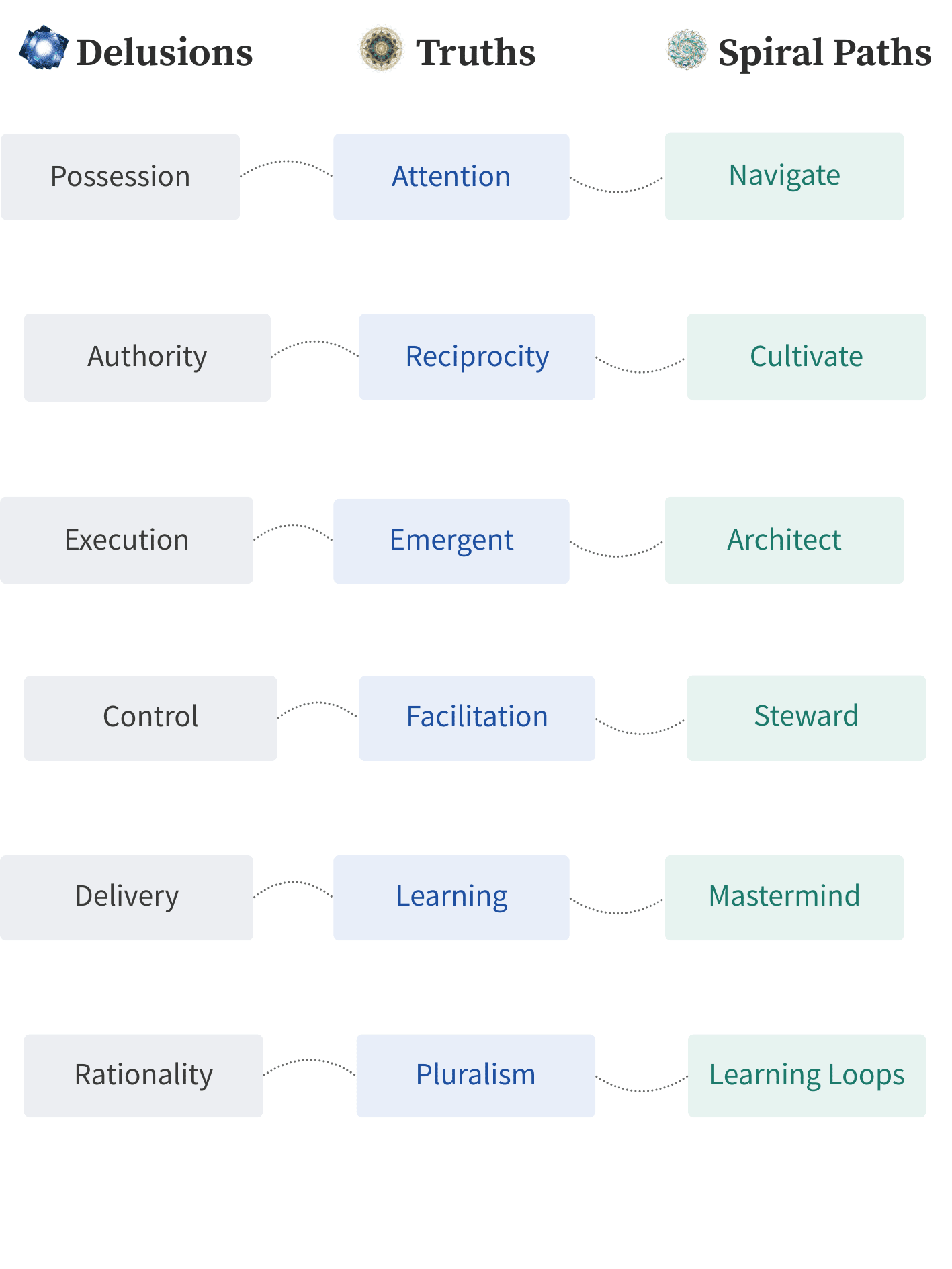
Here are six examples of dominant delusions (of unusual size) that impact organizational knowledge flow.
- Knowledge is a Static Possession
- Knowledge is Hierarchical Authority
- Knowledge is Efficiency of Execution
- Knowledge Leadership is Command and Control
- Knowledge is Just Delivery
- Knowledge is Pure Rationality
Knowledge is a Static Possession
With great power comes great…great mountains of artifacts — not Spiderman

This delusion confuses knowledge with static assets: documentation, dashboards, models, data warehouses, style guides, project plans. All the inert information we store, quantify, tag, control, and defend.
We treat knowledge as a treasure, hoarded and guarded by dragons.
Facts do not generate intelligent organizations. Yet we persist in producing as many artifacts as possible, as if knowledge can be transmitted via manuscript alone.
This includes facts stored in your own mind. Winning at Jeopardy! or recalling trivia at lightning speed is impressive and requires devoted practice. But this practice trains storage and rapid retrieval, not (necessarily) knowledge.
Knowledge is not something you possess. Knowledge is something you do. Knowledge is: interpretation, connection, application, contextual awareness, collaboration, synthesis, adaptation, and meaning making.
A living process. Shaped by time, shared energy, and attention. Applying new insights and changing your own mind.
- The strategy deck becomes knowledge when the relationships in the system have shifted and everyone can act on it without friction.
- Data becomes knowledge when people access the right information, in the right context, at the right moment, to do something valuable they could not do before.
- The Technology-Specific Expert generates knowledge when their expertise becomes part of the team’s skillset instead of a bottleneck.
- A JIRA ticket generates knowledge when the team notices the real problem and proposes a better way to achieve the underlying goal.
- The fancy reporting dashboard becomes knowledge when it reveals why something is slow. (It never will.)
Knowledge is Hierarchical Authority
Help! Help! I’m being epistemologically repressed! — not Monty Python and the Holy Grail

This delusion treats organizational hierarchy as a knowledge system. It assumes that knowledge can be handcrafted in a boardroom and handed down to teams like Halloween candy. If knowledge isn’t a possession, it can’t be something owned by “leadership” or dispensed by institutions.
In the United States this myth is practically an origin story. The founders believed that landed gentry were inherently more rational, better informed, more fit to decide. Corporations inherited this monarchical structure, and our education system was built to produce expectation-meeting industrial labor for a small leadership class.
We still confuse social position with knowledge. Academic prestige, job title, wealth, brand visibility, follower counts, and election are forms of authority, not (necessarily) knowledge skills. We might apply knowledge from a powerful position but power is not epistemology.
When a group has the authority to decide who gets to speak, who get believed, and who is ignored, they reinforce epistemic gated communities. Defining who counts as knowledgeable. Gender essentialism is a good example, The myth that men are objective and women are emotional was produced by a culture in which women had no authority to define objectivity. Or, biology.
Knowledge is a social proccess. It arises through reciprocity – exchanging information, perspective, and experiences across a system of relationships. People working together to interpret, synthesize, and act.
Relational reciprocity doesn’t mean “everyone’s opinion is equally valid”. Opinion is not knowledge. The goal isn’t agreement. The goal is coherence, soundness and … making sense.
Knowledge flows when the CTO’s systemic pattern recognition meets the Head of Product’s understanding of user behavoir meets the junior engineer’s intimate knowledge of the code. It emerges in relationships, not boardrooms.
Knowledge is Efficiency of Execution
There is no spoon. There is only your manager who does not bend. - not The Matrix

This delusion elevates efficiency, throughput, and control are the pinnacle of organizational intelligence. An intelligence measured by the ability to execute tasks faster, smoother, and with fewer ‘mistakes’. Knowledge is generating better compliance with orders…
This mindset is inherited from scientific management. A world that rewards predictability, schedule adherence, and minimization of variance. Celebrates the fantasy of the pure, detached mind—a neutral, rational observer discovering “the one right answer".
And punishes reflection, ambiguity, curiosity, sensing, and self awareness They introduce doubt. They distract attention from finding solutions that are quick, certain, concrete, and unambiguous.
Then we wonder why we are buried under brittle “legacy” systems that can’t evolve or adapt. We optimized for efficiency and execution. We reduced complexity by paving over reality.
But reality will always emerge.
Efficiency is the enemy of effectiveness. – Dan North
Processes optimized for knowledge flow make sense of problems. Decisions and actions are informed, timely, and connected to context. There are no fire drills … unless there are actual, literal, fires.
Knowledge emerges from well-architected patterns of interaction, learning habits, and sound constraints. When there is slack, reflective learning, and pattern detection in the execution process … meaning can emerge.
The fear is always “but we don’t have time for that!”
Enabling meaningful, effective action takes far less time than building six “solutions” that don’t solve the problem. And leave new ones in their wake.
Knowledge Leadership is Command and Control
The first rule of Knowledge Club is: You do not talk about Knowledge Club.— not Fight Club

Since the Enlightenment, we’ve told ourselves a story about progress. We are climbing a linear stairway to heaven, becoming staggeringly more knowledgeable with each passing step.
Go us. We’ve been to the moon! We invented iPhones! We doubled the human lifespan.
Alas, the story conveniently ignores anything that doesn’t fit the plot. The feedback loops revealing that we are also manufacturing our own extinction.
- We’ve wiped out 85% of large land mammals
- And most of the rainforests.
- Microplastics are found in unborn babies.
- We’ve lost over 90% of crop diversity in the last century.
- Many farmlands have less than 60 years of life left.
- Data centers and factory farms emit more carbon than all forms of transportation. (While we buy electric cars.)
Command and control knowledge leadership are produces systems that are equally unsustainable, even when they appear to thrive on the surface. Underneath, there is degradation (we call it “tech debt”). Systems that can’t recover because they can’t adapt.
When leaders mirror this myth by chasing dominance, they reproduces the same epistemic faults:
- Ignoring or suppressing feedback.
- Believing that linear fixes can control nonlinear problems.
- Adapting only when threatened, rather than building adaptive capacity.
- Reacting to vulnerability as a flaw instead of a signal.
When leadership does not facilitate decision making based on feedback and experience, the environments they govern must obey fixed rules. But circumstances change. Patterns evolve. Critical information arrives too late. Today’s solution become tomorrow’s business-critical crisis.
Control becomes fragility.
Leadership is not commanding a world without uncertainty. Knowledge leadership is stewardship of an adaptive system – one that grows increasingly responsive to change.
Knowledge is Just Delivery
Show me the knowledge! — not Jerry Maquire

W. Edwards Demming said:
Every system is perfectly designed to get the result that it does.
The myth that knowledge flow ends at delivery (except for raking in the revenue) designs a system that can not learn. A system that cannot reveal what matters, expose our blindspots, and (perhaps most importantly) cannot maintain a relationships with the real world … as it grows and changes.
Unless we are delivering something to a vacuum, impacts will happen after delivery. New experiences will happen after delivery. Meaning will be understood … after delivery.
If we are not learning from our experiences … there is no knowledge in the loop.
Delivery is not the goal – it is the midpoint of the knowledge cycle. A test. A hypothesis. A probe. The beginning of a new direction – one that may lead you forward, elsewhere, or right back where you started.
Pay attention.
Many of the problems we are frantically solving today are caused by gaps in our learning cycles. Chances are, if slow down enough to look, we’d see the problem in a new light.
A knowledge system is not a pipeline to production. It is a system that we can design. Every role participates in this design, is part of the learning loop. Every organization benefits from a system that is not just resilient but thrives in changing and challenging circumstances.
Delivery can teach us:
- Where new ideas originate in the process.
- What people do when given new options.
- Which recommendations were well-constructed and which concealed hidden flaws.
- Where meaning falls into gaps between teams and how those gaps can be bridged.
- The unexpected impact of our actions.
- The value (or or illusion of value) of our strategies and estimates.
- The next step on the journey,
Knowledge is Pure Rationality
I love the smell of knowledge in the morning. — not Apocalypse Now

The myth of “hard” versus “soft” skills cripples organizational intelligence.
When we treat data, logic, and analytical reasoning as the only legitimate cognitive mode, we miss the nuance inherent in everything. Our minds are one organ in a system of information gathering. To understand the complexity we all face, we also need, embodied, emotional intelligence, intuition, relational attunement, creative insight.
Human systems are cognitive ecologies that need systemic ways of thinking.
Experience is valuable but not if we only apply it to climbing a linear ladder towards certainty. Experience is a spiral pathway, teaching us slant. Knowledge is a lifelong process that includes developing tacit knowledge that we can’t easily articulate.
Wisdom is shared through experiences and meaning structures we create for others. AI is a perfect example. So much hype, so much fear, so much scientific interest, so much money … and yet, it’s primary impact is relational.
In response to the memo described earlier, Capgemini summed this aspect up perfectly.
Leaving the Fire Swamp
If some of this chapter feels uncomfortable, implausible, or outright wrong – that’s okay. You aren’t supposed to take my word for it.
Knowledge doesn’t arise from agreement; it arises from synthesizing diverse perspectives and experiences. Everyone is on their own journey, and none of our paths will be exactly the same.
You can survive, even thrive, inside the Fire Swamp. Many organizations do. Many books will encourage you to master these myths, teach you to slay the ROUSs. Many of us who rebel against these myths discover the we never left, not completely. Epistemological myths shape our thinking and experiences.
The Fireswamp is not a single event. It is a place we find ourselves in, again and again, as we cultivate knowledge flow.
You can make it through, again and again. Deftly avoiding flame spurts. Forming teams who pull each other from the lightening sand. Maybe even taking the rats.
We can architect systems that value self-organization, reciprocity, learning, and coherence. Design systems that thrive where meaning moves freely.
But only if we are willing to leave over-reliance on possession, authority, efficiency, and control. Move away from rigid, deterministic delusions.
Thank you, reader friend, for doing the hardest work. The Delusions are loud, confounding, and everywhere.
But they’re not the whole story.
Each delusion an opposite Truth. Each Truth points toward a path forward.
That is where we are heading next. Out of the Fireswamp … follow the white rabbit.
Activity: Make and Use a Glossary
Knowledge can’t flow when people are using the same words to describe different experiences.
Mention the word Agile and you’ll see what I mean. 98% of the time, people mean very different things by “Agile”. Some of our definitions aren’t simple or literal; they are contextual, nuanced and downright dogmatic.
Even common words can trip us up. People presume they are talking about the same thing, but they aren’t. The discussion spirals. Not because people disagree — they are solving different problems and don’t realize it. All because of a word or two.
Sharing the same language is key to Knowledge Flow. In Domain-Driven Design, this is called “ubiquitious language”. Everyone uses the same terms in conversations, code, documentation, and experiences. This enables quicker understanding and a significant decrease in bikeshedding.
Make a list of words that matter. The ones that people must understand in order for you to make sense. As you read, practice, and build your studio — add more, whenever a word’s meaning is essential to share.
I’ve included some relevant terms. Like bikeshedding!
Create and Use a Glossary —>