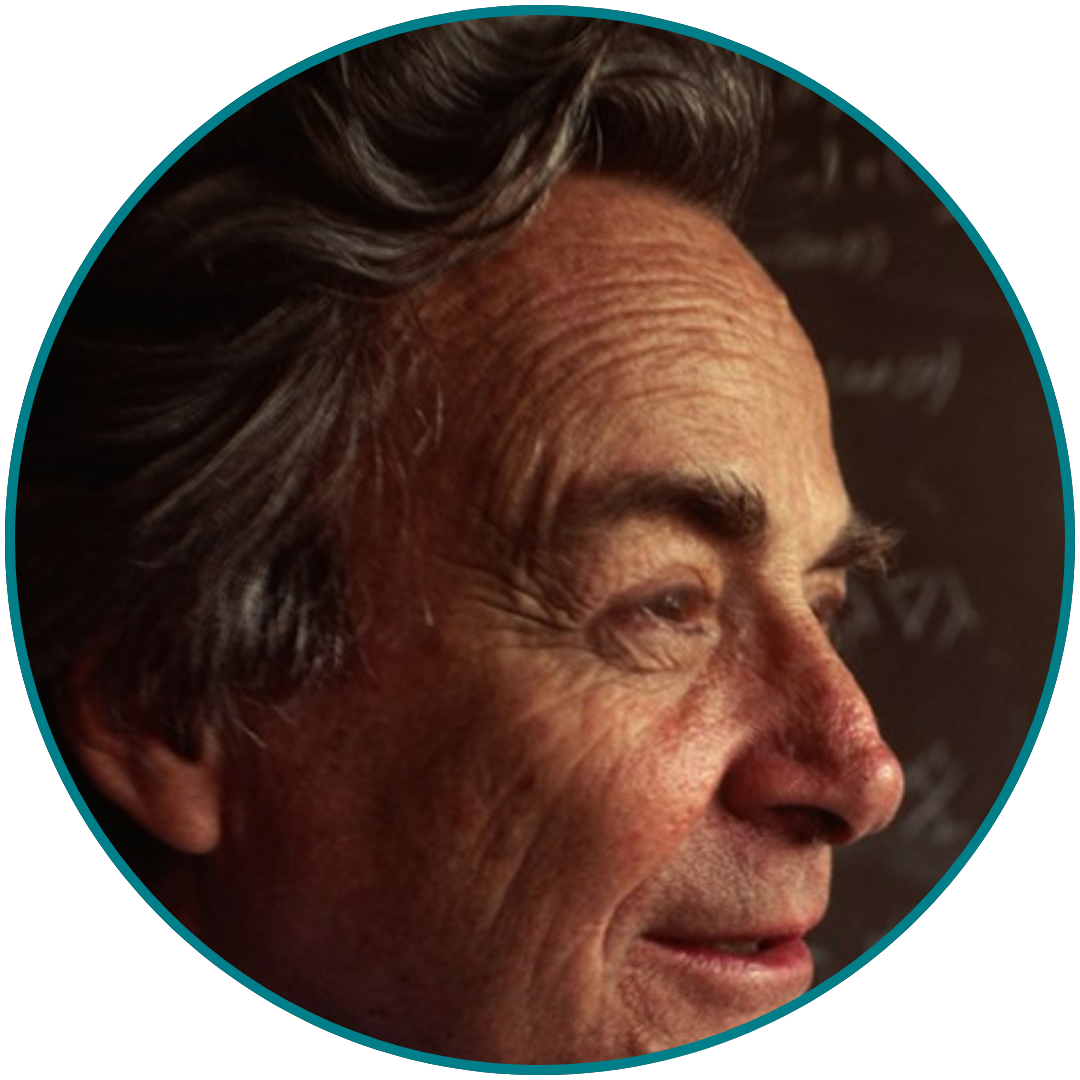
Richard Feynman spent his career investigating some of the most fundamental questions in physics, helping to develop quantum electrodynamics and earning the Nobel Prize in Physics in 1965. His scientific work transformed modern physics, but his broader influence extends far beyond the scientific community.
Feynman became known as an exceptional teacher and communicator. Through lectures, books, interviews, and public appearances, he demonstrated a rare ability to make difficult concepts accessible without oversimplifying them. He believed that understanding should be rooted in mechanisms, relationships, and first principles rather than authority or memorization.
Throughout his life, Feynman maintained a deep distrust of intellectual pretense. He frequently challenged assumptions, questioned accepted wisdom, and emphasized the importance of confronting reality directly. Whether investigating the Challenger disaster, teaching undergraduate physics, or solving technical problems, he consistently sought explanations that matched observable evidence.
Many of Feynman’s stories illustrate a distinctive approach to learning. He approached unfamiliar problems by constructing mental models, experimenting with ideas, and reasoning from fundamentals. His famous reputation for “fixing radios by thinking” captured this mindset: understanding came not from possessing answers, but from seeing relationships clearly enough to reason through a system.
Across his work, Feynman repeatedly emphasized curiosity, intellectual honesty, and the willingness to admit uncertainty. For him, knowledge was not a collection of facts but an ongoing process of inquiry and discovery.
Relevance to Knowledge Flow
Feynman belongs in Knowledge Flow because he exemplifies the difference between information and understanding.
Many systems reward recall, expertise, and the appearance of certainty. Feynman focused instead on explanation, model-building, and the ability to reason about unfamiliar situations. He believed that genuine understanding could be demonstrated through reconstruction: if you truly understand something, you can explain it, adapt it, and use it in new contexts.
His work also highlights the importance of intellectual humility. One of Feynman’s recurring themes was that people are remarkably good at fooling themselves. Knowledge systems therefore require mechanisms for questioning assumptions, testing beliefs, and reconnecting ideas to reality.
Knowledge Flow is fundamentally concerned with how understanding emerges and evolves. Feynman’s approach provides a powerful model for that process. He treated learning as active inquiry rather than passive consumption and viewed knowledge as something to be explored, challenged, and continually refined.
His influence can be seen throughout the domains of learning, systems thinking, inquiry, and sensemaking. More than almost any modern thinker, Feynman demonstrates what it looks like to engage the world with curiosity, rigor, and a commitment to understanding how things actually work.