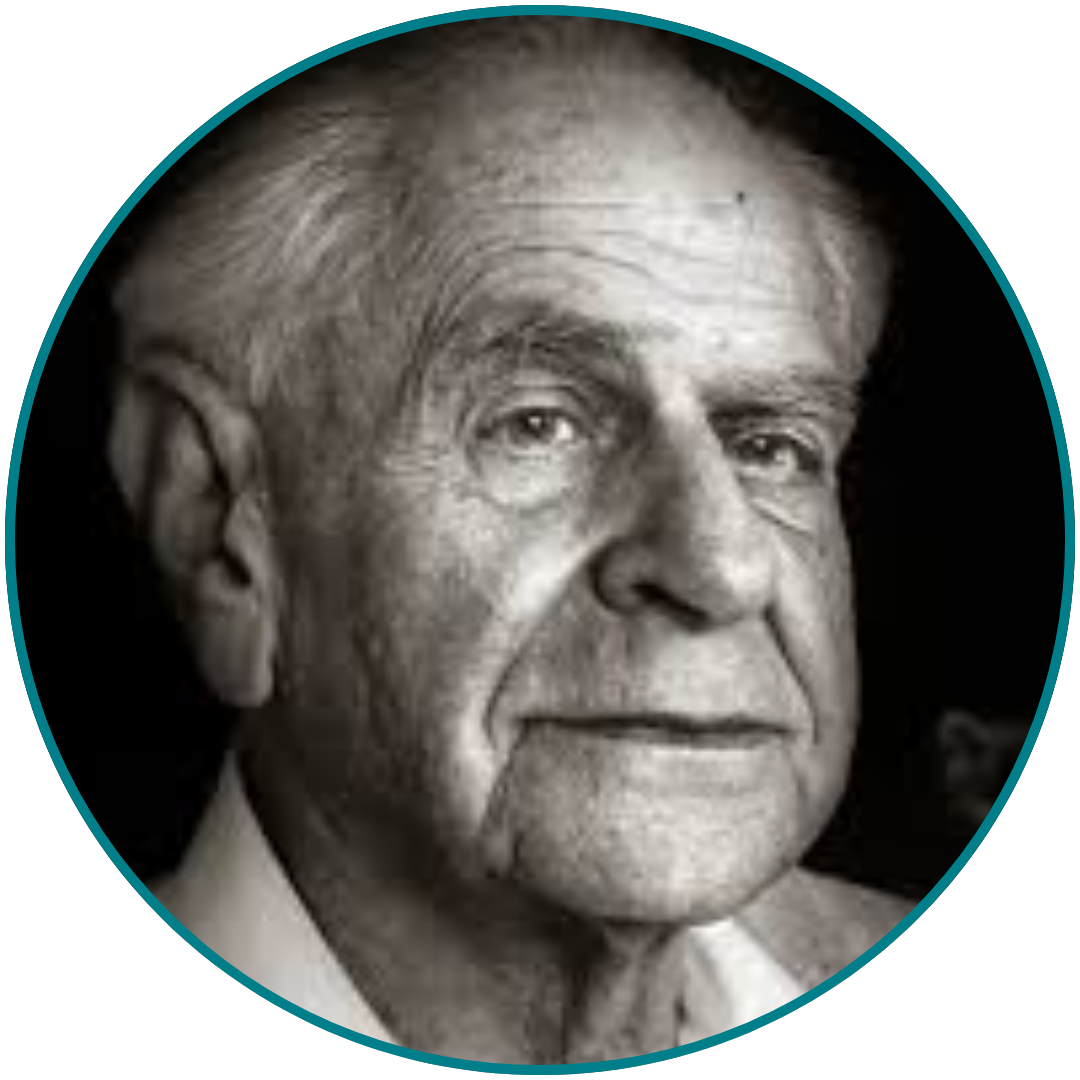
Karl Popper was a philosopher whose work fundamentally reshaped modern understandings of science, knowledge, and learning. Rejecting the idea that certainty could ever be fully achieved, Popper argued that progress emerges through conjecture and refutation: proposing explanations and continually testing them against reality.
His concept of falsifiability emphasized that meaningful claims must remain vulnerable to challenge and revision. For Popper, knowledge is not a stable accumulation of unquestionable truths, but an evolving process of error correction and adaptive learning.
This perspective extended beyond science into politics, culture, and organizational life. Popper warned against closed systems of thought that suppress criticism, discourage questioning, or mistake authority for truth. Such systems, he argued, become incapable of learning because they protect assumptions instead of testing them.
His defense of open inquiry and critical discourse positioned disagreement not as failure, but as a necessary condition for collective intelligence and progress.
Relevance to Knowledge Flow
Popper’s work highlights one of the deepest principles underlying Knowledge Flow: learning requires permeability to reality.
Knowledge systems stagnate when assumptions harden into ideology, when criticism becomes unsafe, or when certainty replaces inquiry. Adaptive intelligence depends on the ability to test interpretations, surface errors, revise models, and remain open to new evidence.
His work reinforces the importance of epistemic humility within sociotechnical systems. Knowledge Flow is not the elimination of uncertainty — it is the continual refinement of understanding through participation, experimentation, and learning across time.